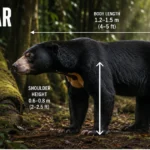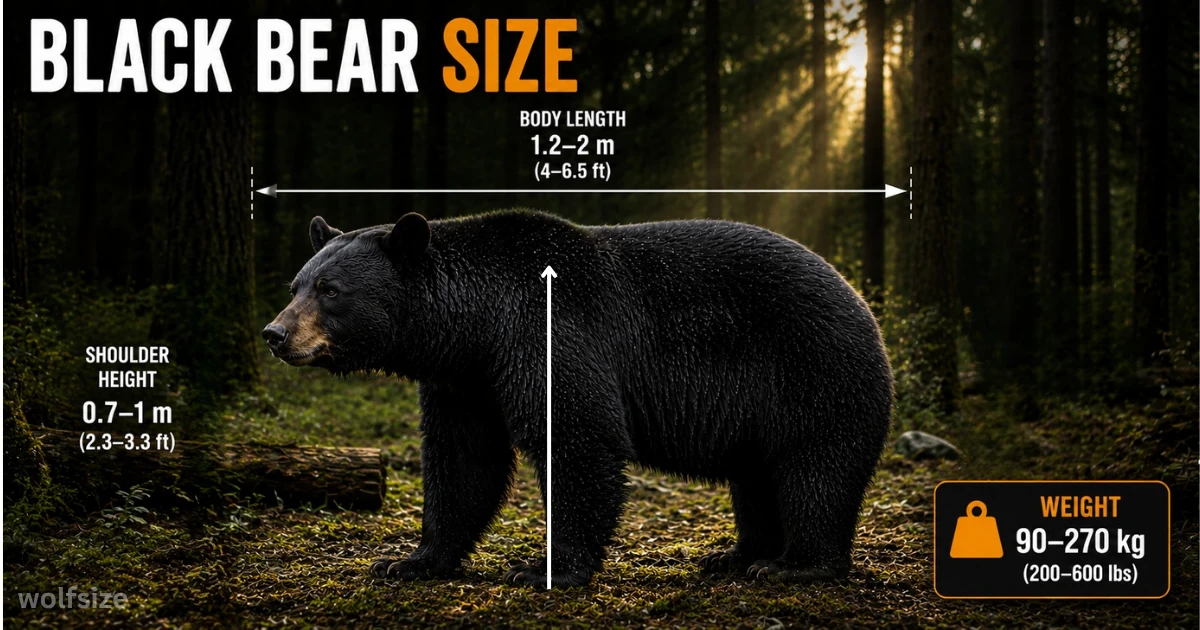
Black bear size varies depending on age, sex, and location. An adult American black bear typically weighs between 90–270 kg (200–600 lbs), stands about 0.7–1 meter (2.3–3.3 feet) tall at the shoulder, and measures around 1.2–2 meters (4–6.5 feet) in body length.
Large male black bears can exceed 600 pounds, making them one of the largest terrestrial mammals in North America, although they are much smaller than polar bears and Kodiak bears.
Black bears are the most common bear species in North America. They’re also the smallest of the three bears found on the continent — but “smallest” doesn’t mean small.
In this guide, you’ll get real numbers for weight, height, and length — plus how black bears stack up against other bears and against us.
How Big Is a Black Bear?
Average Black Bear Weight (Male vs. Female)
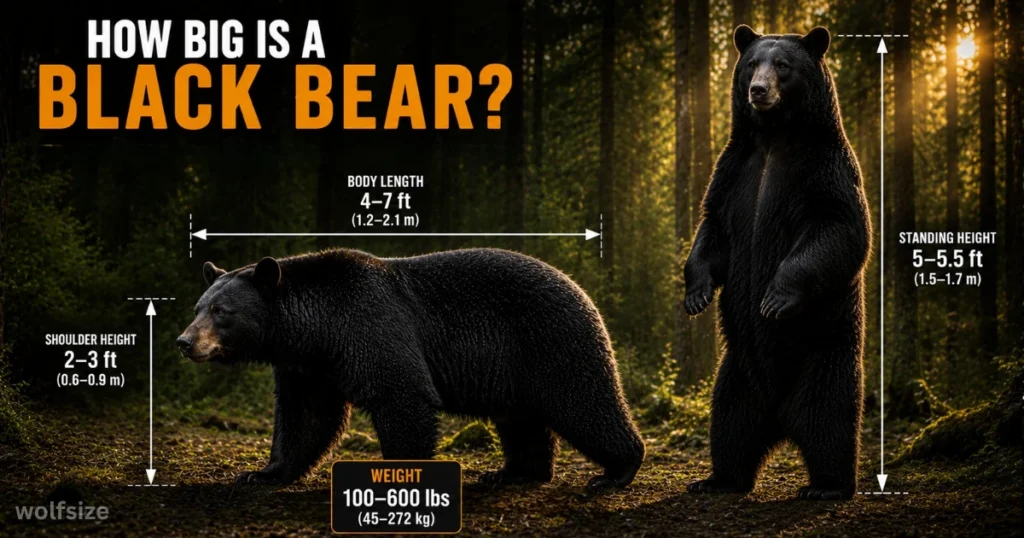
Male black bears are the heavyweights. Adult males typically weigh 250 to 600 pounds, though most fall in the 250–400 pound range depending on region and season.
Female black bears are lighter, usually weighing 100 to 400 pounds. A big male can weigh nearly three times as much as a small female — that’s a huge weight gap for the same species.
Average Black Bear Height at the Shoulder
On all fours, most black bears stand 2 to 3 feet tall at the shoulder. Males average around 40 inches; females rarely top 30 inches.
This is why shoulder height alone is a quick, reliable clue for telling male and female bears apart in the field.
Average Black Bear Length (Nose to Tail)
Body length runs from 4 feet to nearly 7 feet, nose to tail tip. Males typically measure 5 to 6 feet; females measure 4 to 5 feet.
The tail itself is short and barely noticeable — most of that length is body and neck.
Black Bear Standing Height (On Two Legs)
When a black bear rears up on its hind legs — usually to get a better look or sniff the air, not to attack — it can reach 5 to 5.5 feet tall.
That’s roughly eye level with an average adult human, which is part of why an upright bear looks so startling up close.
More Posts:Bear Size Comparison: How Every Bear Species Measures Up
Black Bear Size by Region in the U.S.
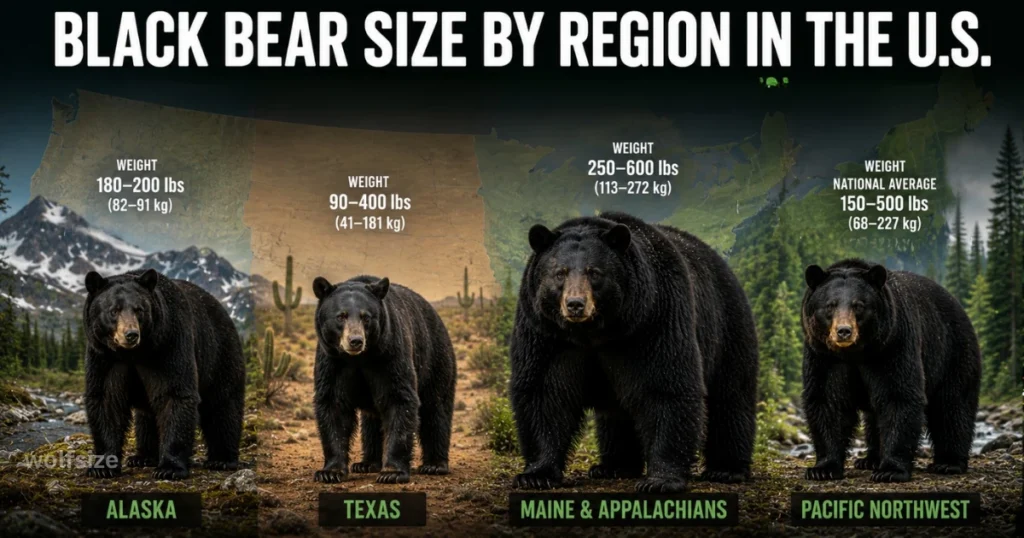
Black Bear Size in Alaska
Alaska is home to roughly 100,000 black bears, the largest population of any U.S. state. Interestingly, Alaskan black bears tend to run smaller than their Lower 48 cousins — adult males often weigh around 180 to 200 pounds in spring, gaining fat through summer and fall before denning.
Black Bear Size in Texas
Texas black bears are a state-threatened species, found mainly in the Trans-Pecos region. Adults here reach 5 to 6 feet in length and 90 to 400 pounds, with size varying based on the harsh desert-scrub habitat they call home.
Black Bear Size in the Eastern U.S. (Maine, Appalachians)
Eastern populations, especially in Maine, tend to run larger thanks to rich forage — nuts, berries, and agricultural crops. Adult males in Maine commonly weigh 250 to 600 pounds, with the biggest bulking up dramatically in late fall before hibernation.
Black Bear Size in the Pacific Northwest and West Coast
West Coast bears benefit from a long growing season and abundant salmon runs in some areas, which supports steady weight gain. Sizes here generally track close to the national average, with heavier individuals found near reliable food sources like salmon streams and berry patches.
More Posts:Kodiak Bear Size: How Big Do These Giant Bears Really Get?
What Affects Black Bear Size?
Diet and Food Availability
Black bears are opportunistic omnivores. Their diet is mostly plant-based — leaves, berries, nuts, and roots — with insects and occasional meat filling the gaps.
Bears with access to rich, reliable food (like salmon runs or mast-heavy forests) grow noticeably bigger than bears in lean, dry habitats.
Seasonal Weight Changes (Spring vs. Fall)
A single bear’s weight can swing by 20% or more across the year. Bears emerge from hibernation lean and hungry in spring, then enter hyperphagia in late summer and fall — an intense feeding drive that packs on fat reserves needed to survive winter denning.
Age and Growth Stages (Cub to Adult)
Cubs are born tiny — under 1 pound at birth, blind and nearly hairless. Growth is rapid through the first few years, but black bears don’t reach full sexual and physical maturity until 3 to 6 years old, depending on habitat quality.
Genetics and Subspecies Differences
There are 16 recognized subspecies of American black bear, and genetics play a real role in maximum size potential. Combined with regional food supply, this is why a Kodiak-area bear and a desert-dwelling Texas bear can look like different animals entirely, despite sharing a species.
Black Bear Size Compared to Other Bears
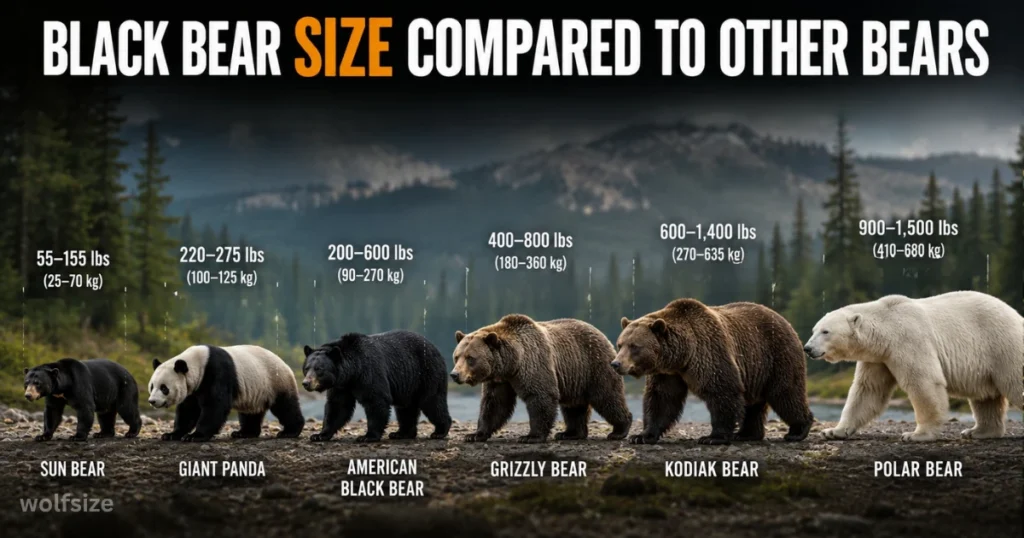
Black Bear vs. Grizzly Bear Size
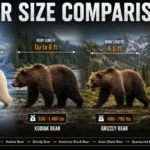
Grizzly bears are considerably bigger. Adult male grizzlies weigh 400 to 800 pounds and stand 3.5 to 4.5 feet at the shoulder — noticeably taller and heavier than even a large black bear. Grizzlies also have a distinctive shoulder hump that black bears lack.
Black Bear vs. Kodiak Bear Size
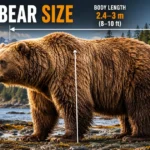
The Kodiak bear, a giant subspecies of brown bear native to Alaska’s Kodiak Islands, dwarfs the black bear. Males can weigh 600 to 1,400 pounds and reach standing heights of 9 to 10 feet — more than double a black bear’s typical weight.
Black Bear vs. Polar Bear Size
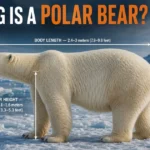
Polar bears are the largest land carnivores on Earth. Adult males average around 1,500 pounds and can stand over 8 feet tall. Next to a polar bear, even a hefty black bear looks modest in size.
Black Bear vs. Panda Bear Size
Giant pandas are actually smaller than most people assume — adult males weigh up to 275 pounds, putting them close to or below the average black bear’s weight, despite their bulky, round appearance.
Black Bear vs. Sun Bear Size
The sun bear is the smallest bear species in the world, weighing just 55 to 155 pounds — roughly a third the size of an average black bear. Sun bears are native to Southeast Asian rainforests, not North America.
More Posts:Largest Bear Ever: Arctotherium Angustidens, the Biggest Bear in History
Black Bear Size Compared to a Human
Standing on all fours, a black bear is roughly knee-to-waist height on an adult human. But reared up on hind legs, it can match or exceed average human height — around 5 to 5.5 feet — while outweighing most people by hundreds of pounds. That combination of speed, reach, and mass is exactly why wildlife agencies stress giving bears distance and space.
How to Tell How Big a Black Bear Is (Field Identification)
Black Bear Track Size
Front tracks from an adult black bear typically measure 4 to 6 inches wide. Female tracks rarely exceed 4.5 inches; tracks wider than that usually belong to a mature male. Track width is one of the most reliable low-effort ways to judge size without ever seeing the bear itself.
Estimating Weight from Body Shape
A bear’s silhouette changes with the season. A lean, narrow-bodied bear in spring likely weighs less than its fall self. A bear with a rounded, heavy-set body and visible fat rolls near the shoulders and hindquarters is likely close to its peak fall weight.
Signs of a Large vs. Small Black Bear
Bigger bears leave bigger sign: wider claw marks on trees, deeper scat deposits, and higher rub marks on bark where they’ve scratched or marked territory. Small or young bears tend to leave lighter, less frequent sign in the same habitat.
Black Bear Size FAQs
How big does a black bear get?
Most adult black bears weigh 150 to 400 pounds and stand 2 to 3 feet tall at the shoulder, though large males can top 600 pounds in food-rich regions.
What is the average weight of a male black bear?
Male black bears average 250 to 600 pounds, with most falling between 250 and 400 pounds depending on region and season.
How tall is a black bear standing up?
Standing on its hind legs, a black bear typically reaches 5 to 5.5 feet tall — close to average adult human height.
Are black bears bigger than grizzly bears?
No. Grizzly bears are bigger, with males weighing 400 to 800 pounds compared to a black bear’s 250 to 600 pounds.
What is the biggest black bear ever recorded?
Confirmed record black bears have exceeded 880 pounds, though such sizes are extremely rare and typically tied to exceptional food access.
How can you tell how big a black bear is from its tracks?
Track width is the quickest clue — tracks over 4.5 inches wide usually belong to a large adult male.
Conclusion
Black bear size isn’t one fixed number — it’s a range shaped by sex, season, region, and food supply. Most adults land between 150 and 400 pounds, but outliers on both ends exist across the U.S.
Whether you’re comparing black bears to grizzlies, sizing up tracks in the field, or just curious how you’d measure up next to one, the numbers above give you the real picture — grounded in wildlife agency data, not guesswork.

Robert Taylor is a content researcher and writer specializing in dimensions, measurements, and size comparison guides. He creates clear, practical content that helps readers understand real-world sizes and measurements with confidence. His work focuses on delivering accurate, easy-to-use dimension information in both U.S. and metric units.