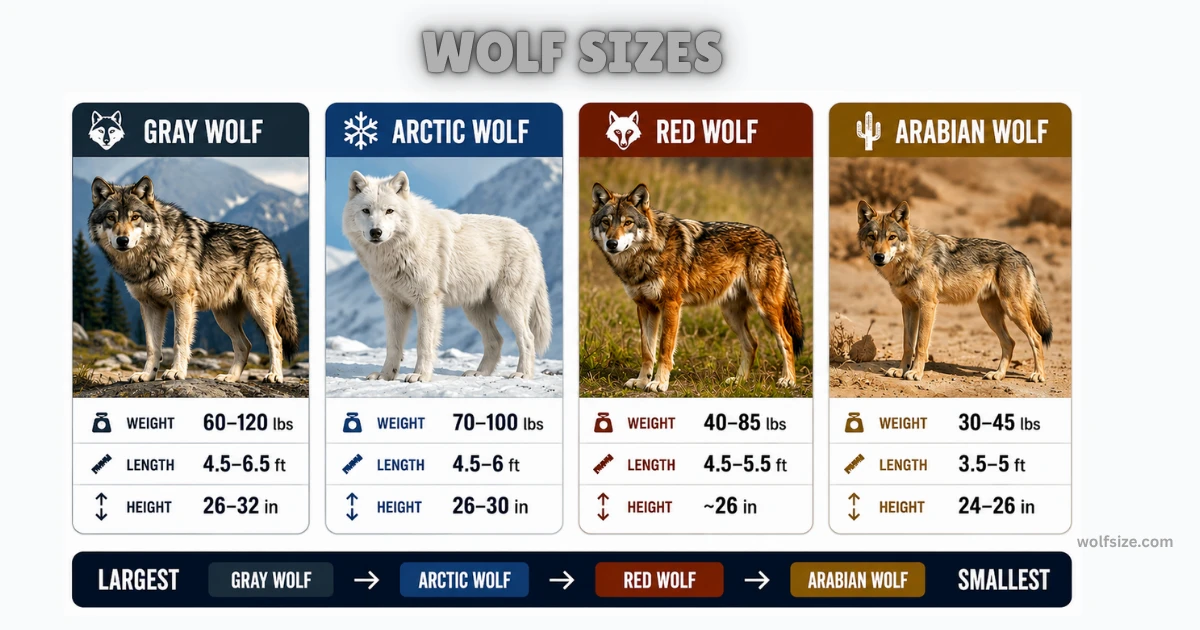
Wolves vary dramatically in size across species and regions, but most fall into a handful of well-known types — including Gray Wolf, Arctic Wolf, Red Wolf, Mexican Wolf, and Arabian Wolf.
Wolf Size at a Glance
| Stat | Gray Wolf |
|---|---|
| Scientific Name | Canis lupus |
| Average Weight | 60–120 lbs (27–54 kg) |
| Length | 4.5–6.5 feet (nose to tail) |
| Shoulder Height | 26–32 inches |
| Lifespan (Wild) | 6–8 years |
| Diet | Elk, deer, moose, bison |
| Habitat | Forests, tundra, grasslands |
Males run about 20% heavier than females — a pattern that holds true across nearly every wolf subspecies.
All Wolf Sizes, Weight, Food Needs, and Special Facts
Gray Wolf
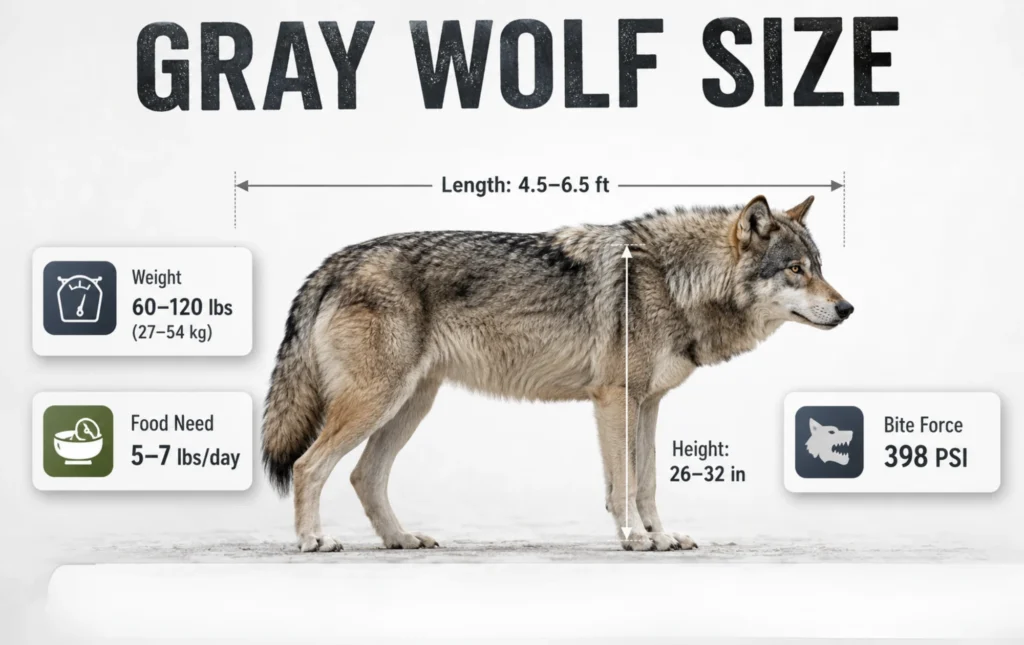
Gray wolves weigh 60-120 pounds, with males in Alaska and Canada reaching up to 130 lbs. They measure 4.5-6.5 feet in length and stand 26-32 inches at the shoulder. For daily food, a gray wolf needs 5-7 pounds to reproduce successfully, can survive on just 2.5 lbs, and can eat up to 22.5 lbs in one sitting.
Over a year, one wolf eats roughly 15-19 deer-equivalents. Its bite force of 398 psi is strong enough to crack open a moose femur for marrow.
Arctic Wolf
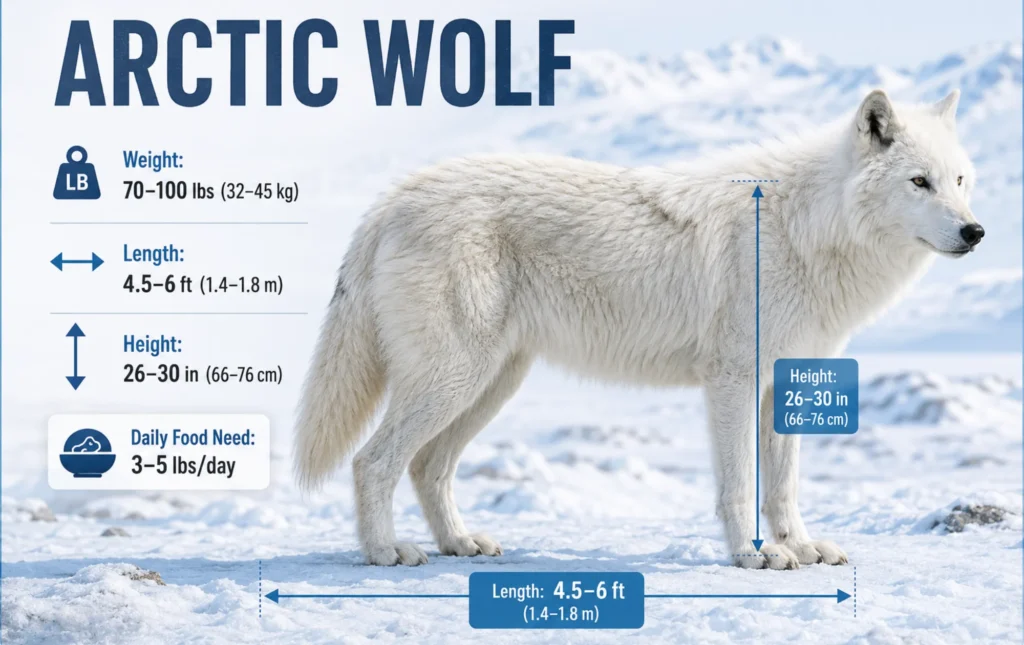
Arctic wolves weigh 70-100 pounds and are similar in length to gray wolves, though with slightly shorter limbs. Height runs 26-30 inches at the shoulder, and daily food need is 3-5 pounds, depending on prey availability.
Thick white fur and extra body fat help this subspecies survive brutal Arctic winters.
Red Wolf
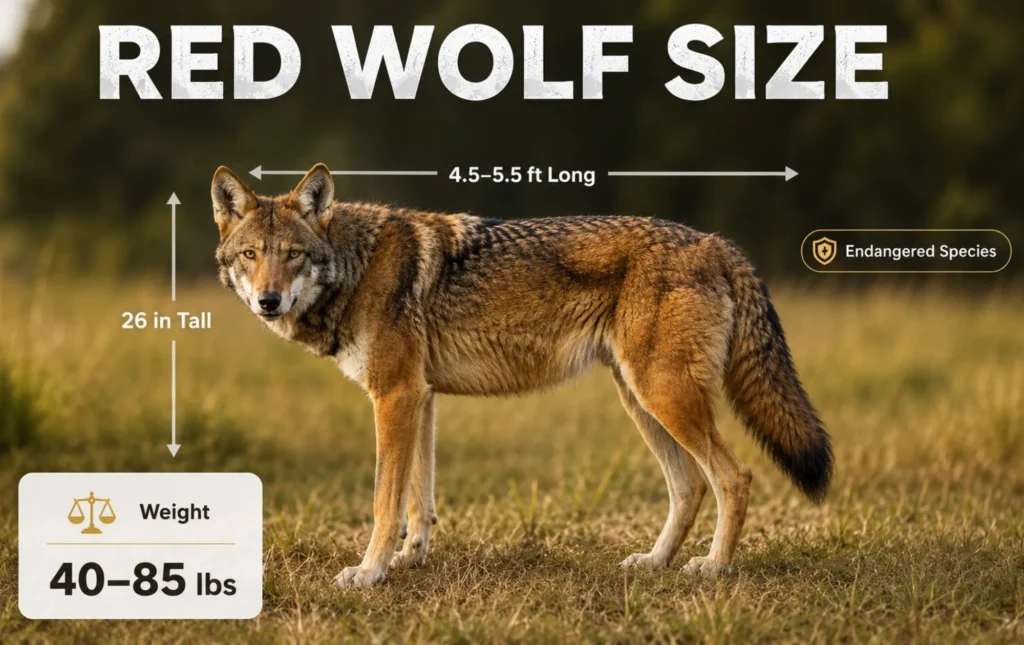
Red wolves weigh 40-85 pounds and measure 4.5-5.5 feet in length, standing around 26 inches at the shoulder. Daily food need is 2-5 pounds.
This subspecies is federally endangered, with wild populations limited to a small recovery area in coastal North Carolina.
Mexican Wolf
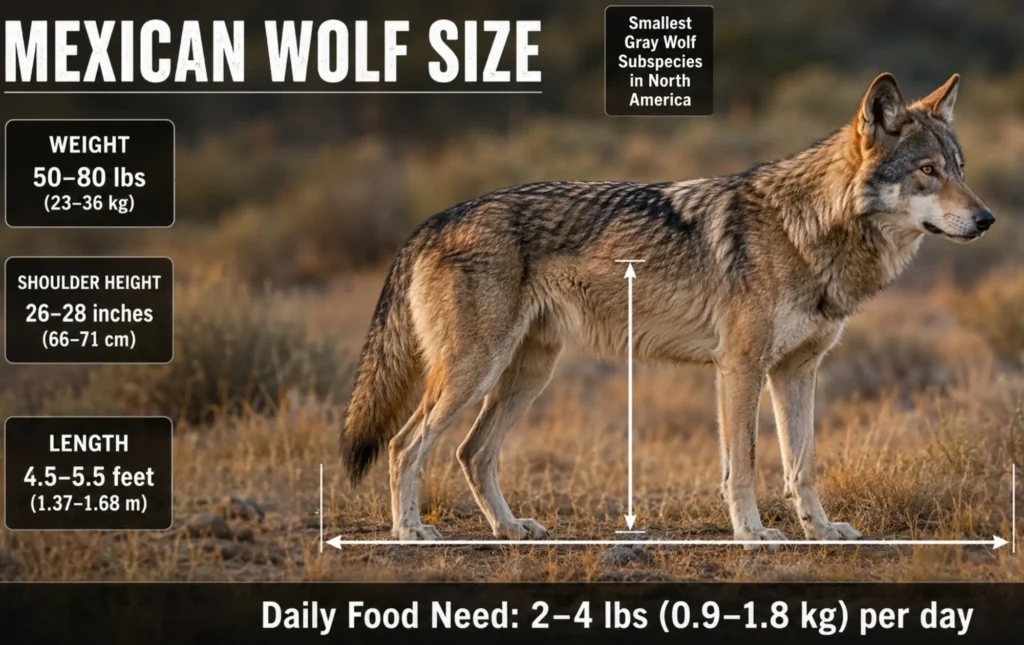
Mexican wolves weigh 50-80 pounds, shorter overall than northern gray wolves, with a shoulder height around 26-28 inches. Daily food need is 2-4 pounds.
This is the smallest gray wolf subspecies in North America, currently part of an active reintroduction program across Arizona and New Mexico.
Arabian Wolf
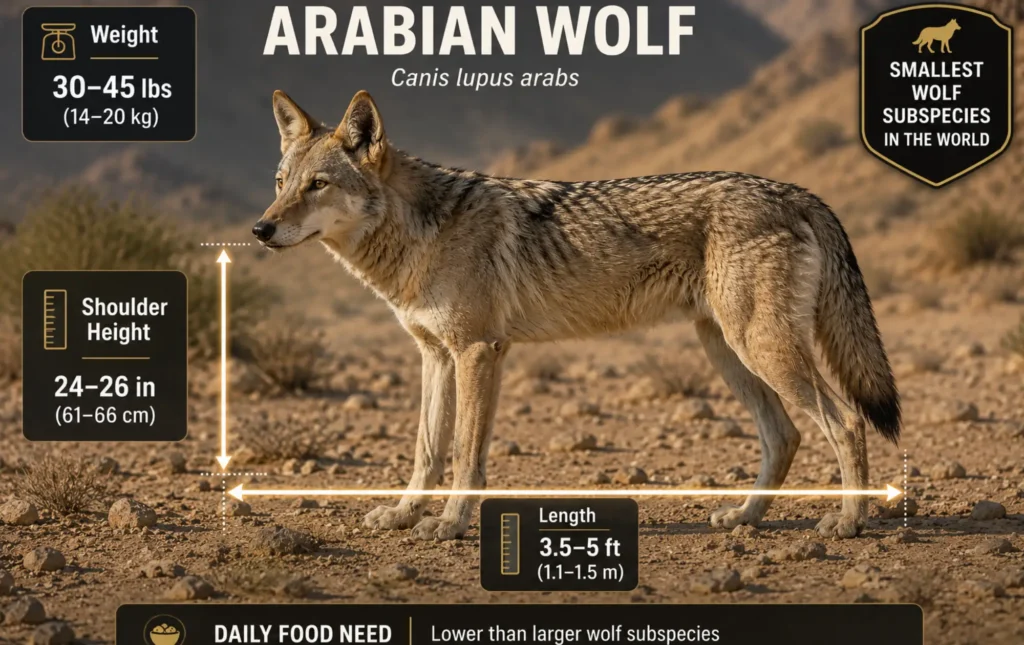
Arabian wolves weigh as little as 30 pounds, with a noticeably smaller frame, shorter legs, and a compact build compared to northern wolves. Daily food need is lower than larger subspecies, matching its smaller body mass.
This is the smallest known wolf subspecies worldwide, adapted for hot, dry conditions across the Middle East.
Quick Reference — Daily Food Needs by Wolf Type
| Wolf Type | Daily Food Need |
|---|---|
| Gray Wolf | 2.5–7 lbs (1.1–3.2 kg) |
| Arctic Wolf | 3–5 lbs (1.4–2.3 kg) |
| Red Wolf | 2–5 lbs (0.9–2.3 kg) |
| Mexican Wolf | 2–4 lbs (0.9–1.8 kg) |
| Arabian Wolf | Lower than larger wolf subspecies (smaller body size) |
Special Facts Across All Wolves
- 42 teeth total, compared to just 32 in humans
- Top speed: 35-38 mph in short bursts while chasing prey
- Daily travel range: up to 50 miles while hunting for food
- Litter size: 4-6 pups, each weighing about 1 pound at birth
- Gestation period: 63 days, consistent across nearly all wolf species
Wolf vs Coyote vs German Shepherd Size
| Category | Gray Wolf | Coyote | German Shepherd |
|---|---|---|---|
| Weight | 60–120 lbs (27–54 kg) | 20–50 lbs (9–23 kg) | 50–90 lbs (22–40 kg) |
| Length | 4.5–6.5 ft | 3.5–4.5 ft | 3.5–4 ft |
A wolf’s paw print measures about 4.5 inches long by 3.5 inches wide — roughly the size of an adult human’s palm, and nearly double the size of a coyote’s 2.5-inch track.
Wolf Size Compared to Human
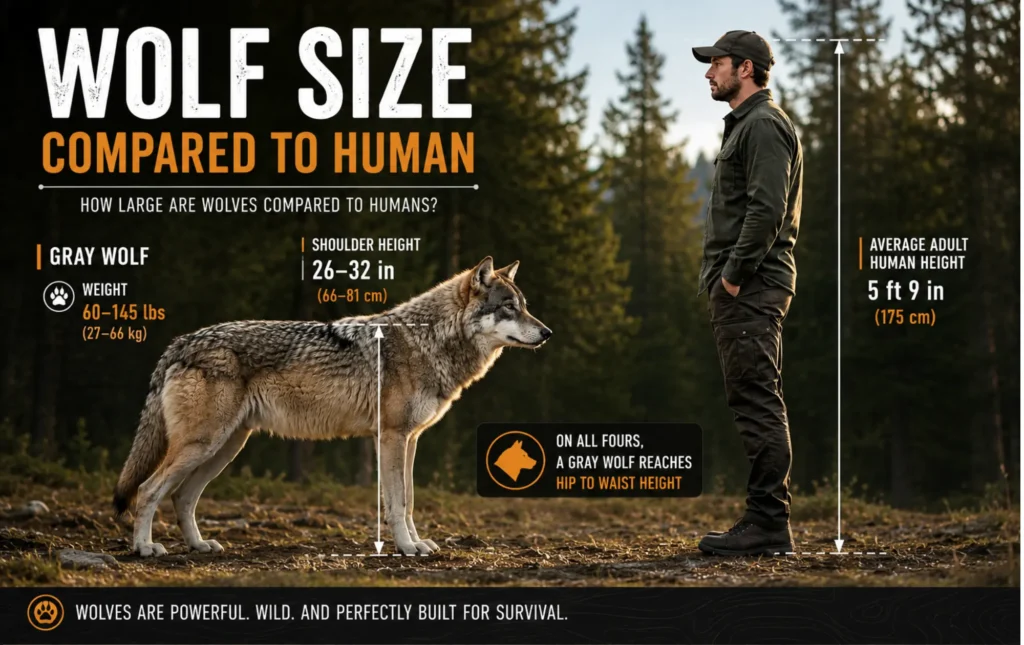
An adult gray wolf weighs 60–145 lbs (27–66 kg) and stands 26–32 inches at the shoulder, reaching roughly hip to waist height on an average adult human when on all fours.
Wolves are typically lighter than the average human male, who weighs around 197 lbs (89 kg) and stands 5 feet 9 inches tall. On its hind legs, a wolf can stand 5 to 7 feet tall — nearly eye-level with a person.
FAQ’s About Wolf Size
How much does an average wolf weigh?
Adult gray wolves weigh 60-120 pounds, depending on sex, region, and subspecies.
How long is a wolf from nose to tail?
Most adult wolves measure 4.5 to 6.5 feet including the tail.
What is the biggest wolf species?
The gray wolf is the largest wolf species, with northern subspecies in Alaska and Canada reaching up to 143 pounds.
Are male wolves bigger than female wolves?
Yes. Males average about 20% larger than females in weight and length.
How tall is a wolf at the shoulder?
Gray wolves stand 26-32 inches tall at the shoulder.
Is a wolf bigger than a German Shepherd?
Yes. Wolves are typically taller, longer, and have bigger paws than a German Shepherd, though weight ranges can overlap.
What is the smallest wolf subspecies?
The Arabian wolf, found in the Middle East, is among the smallest — some adults weigh only 30 pounds.
How big is a wolf’s paw print?
A typical gray wolf track is about 4.5 inches long and 3.5 inches wide.
Do wolves get bigger in colder climates?
Yes. Wolves in colder northern regions tend to be larger than wolves in warmer southern regions, following Bergmann’s Rule.
At what age do wolves reach full size?
Wolves reach adult size within 1-2 years, looking fully grown by their first autumn.