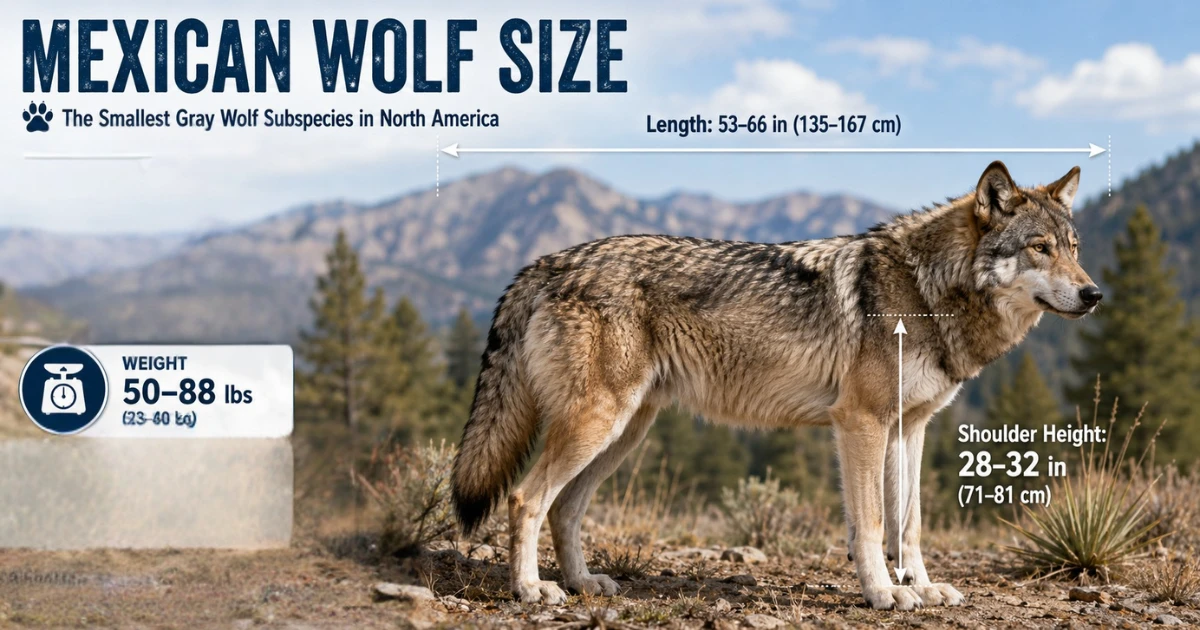
The Mexican gray wolf (Canis lupus baileyi) is the smallest gray wolf subspecies in North America.
But small is relative. This wolf is still a powerful, fast predator built for mountain terrain — and its size tells the whole story of how it survives.
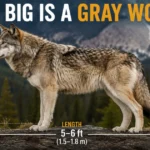
An adult Mexican wolf typically stands 28–32 inches (71–81 cm) at the shoulder, stretches 53–66 inches (135–167 cm) from nose to tail, and weighs between 50–88 lbs (23–40 kg).
That’s roughly the size of a large domestic dog — but leaner, faster, and built to hunt.
Mexican Wolf Size at a Glance
| Measurement | Range |
|---|---|
| Body Length | 53–66 in (135–167 cm) |
| Shoulder Height | 28–32 in (71–81 cm) |
| Weight | 50–88 lbs (23–40 kg) |
| Tail Length | ~12–16 in (approx.) |
A few things stand out right away.
The weight range is wide. A small adult female and a large adult male can differ by nearly 35–40 lbs.
The coat is striking too — a blend of buff, rust, gray, and black, sometimes with unique facial patterns. It’s not just beautiful. It’s camouflage perfectly matched to the pine-oak highlands of Arizona and New Mexico.
Male vs. Female Mexican Wolf Size
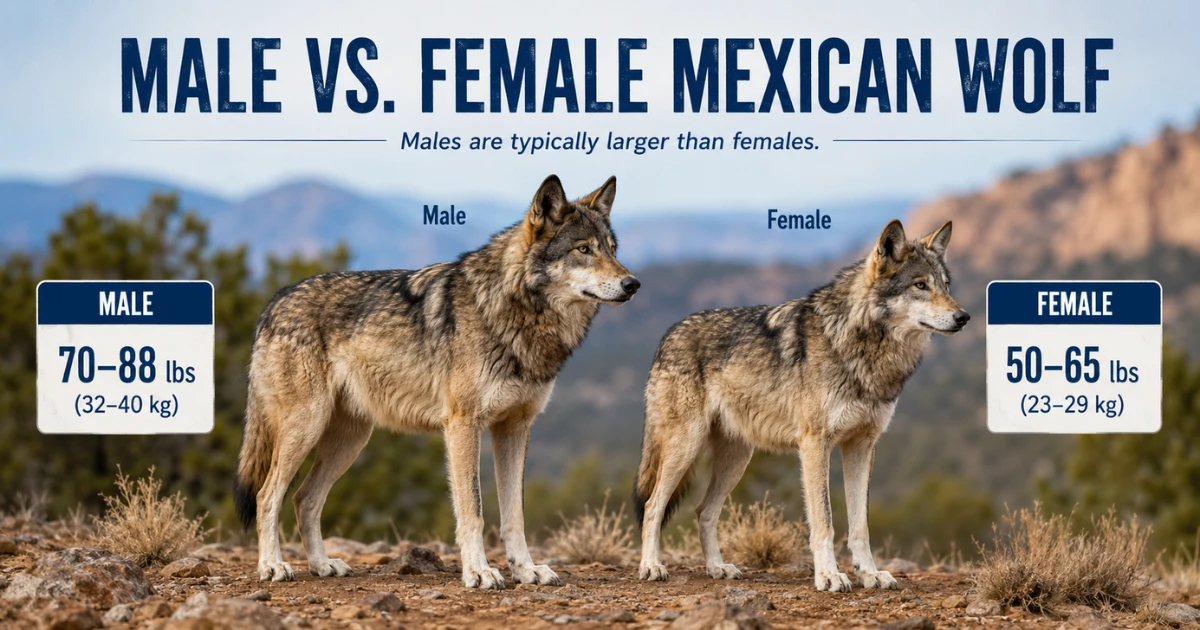
Like all wolf subspecies, male Mexican wolves are larger than females.
Males push toward the upper weight range — closer to 70–88 lbs. Females typically fall between 50–65 lbs.
This difference isn’t just physical. In a wolf pack, the alpha pair leads hunts and defends territory. A larger male has more strength for bringing down white-tailed deer and mule deer — the lobo’s primary prey.
Females, while lighter, are highly efficient hunters. Their smaller frame may actually help during denning season, when a mother needs to move in and out of tight shelters while caring for pups.
Pups of both sexes look nearly identical at birth — weighing around 1 lb. By age two to three, when they reach full maturity, the size gap between males and females becomes clearly visible.
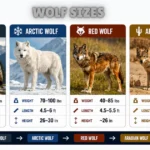
Mexican Wolf Size vs. Other Wolves
How does the Mexican wolf compare to its relatives?
| Feature | Mexican Gray Wolf | Gray Wolf | Northwestern Wolf |
|---|---|---|---|
| Shoulder Height | 28–32 in | 27–32 in | 27–36 in |
| Body Length | 53–66 in | 50–70 in | 60–84 in |
| Weight | 50–88 lbs | 75–125 lbs | 79–159 lbs |
| Build | Lean, agile | Medium frame | Heaviest subspecies |
The Northwestern wolf — the largest gray wolf subspecies — can weigh nearly double the heaviest Mexican wolf. That’s a dramatic size difference within the same species.
The general gray wolf of the northern Rockies also outweighs the Mexican wolf by 30–40% on average.
Mexican wolf vs. coyote
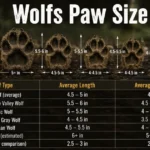
| Feature | Mexican Gray Wolf | Coyote |
|---|---|---|
| Weight | 50–88 lbs | 20–40 lbs |
| Build | Stocky chest, broad muzzle | Narrow, pointed snout |
| Track | Large, round | Smaller, oval |
| Travel Pattern | Pack, straight-line | Solo or pairs, zig-zag |
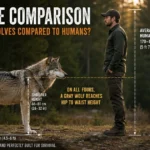
How Big Is a Mexican Wolf Compared to a Human?
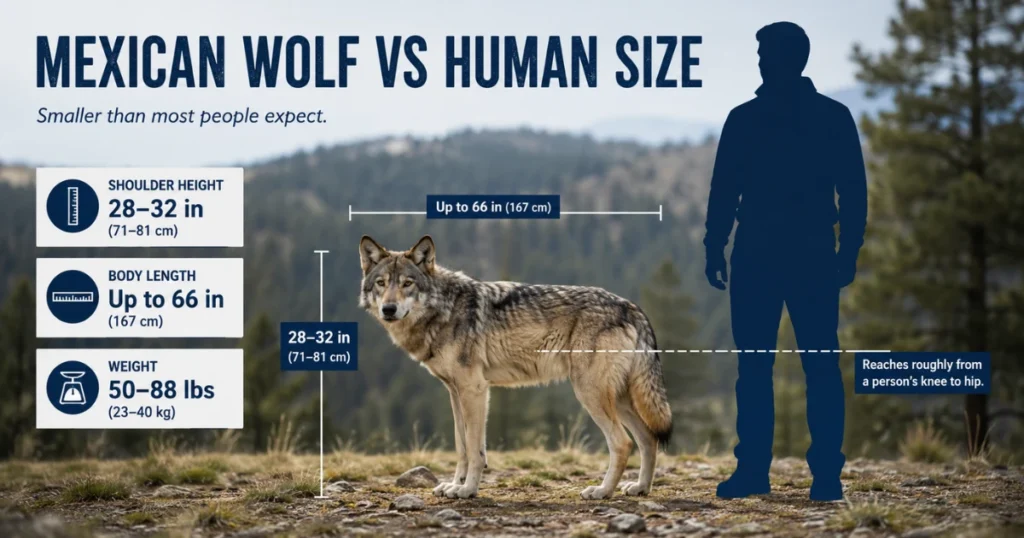
Standing at 28–32 inches at the shoulder, a Mexican gray wolf would reach roughly between a person’s knee and hip.
Its body length of up to 66 inches — over 5 feet nose to tail — makes it longer than most people expect from an animal described as “small.”
A large male at 88 lbs is comparable in weight to a medium-sized adult human.
Think of it like a lean, powerful German Shepherd — but with longer legs, a broader chest, a more powerful jaw, and an instinct shaped by thousands of years of hunting in the wild.
Why the Mexican Wolf Is Built This Size
Every measurement connects back to one thing: survival in a specific environment.
The Mexican wolf evolved in the warm, mountainous terrain of the southwestern United States and central Mexico. This environment shaped its body.
Bergmann’s Rule explains it clearly — animals living in warmer, lower-latitude regions tend to evolve smaller body sizes. Less mass means less heat buildup in a warm climate. It’s the same reason the Arabian wolf is even smaller than the Mexican wolf, while the Arctic wolf is one of the heaviest subspecies.
A compact, agile body also suits the lobo’s hunting style. It chases white-tailed deer and mule deer through dense pine-oak forests and across rocky slopes — terrain where speed and maneuverability beat raw size.
Its long legs relative to body mass give it a quick, ground-covering stride. Its sleek torso reduces drag when running through brush. And its superior sense of smell — not size — is its most powerful hunting tool
FAQ — Mexican Wolf Size
How big is a fully grown Mexican wolf?
A fully grown Mexican wolf stands 28–32 inches at the shoulder, measures 53–66 inches from nose to tail, and weighs 50–88 lbs. Males are larger than females.
What is the average Mexican wolf weight?
The average weight runs 50–88 lbs. Large males sit toward the top of that range. Females are typically 35–40% lighter.
Is the Mexican wolf the smallest gray wolf?
Yes. The Mexican gray wolf is the smallest subspecies of Canis lupus in North America. Only the Arabian wolf (Canis lupus arabs) is smaller globally.
How does a Mexican wolf compare to a coyote?
Mexican wolves are significantly larger — roughly double the weight of most coyotes. They have broader chests, wider muzzles, bigger tracks, and move in tight packs rather than solo.
Why is the Mexican wolf so small compared to other wolves?
Bergmann’s Rule explains much of the difference: wolves from warmer, southern climates evolve smaller bodies. The Mexican wolf adapted to the Southwest’s mountain terrain, unlike the colder northern habitats of heavier wolf subspecies.
How many Mexican gray wolves are left in the wild?
As of 2024, approximately 286 live in the United States (Arizona and New Mexico) and 45–50 in Mexico. The total wild population is roughly 330 individuals.

Robert Taylor is a content researcher and writer specializing in dimensions, measurements, and size comparison guides. He creates clear, practical content that helps readers understand real-world sizes and measurements with confidence. His work focuses on delivering accurate, easy-to-use dimension information in both U.S. and metric units.