A wolf paw typically measures about 4–6 inches (10–15 cm) long and 3.5–5 inches (9–13 cm) wide, making it roughly the size of an adult human hand. An adult gray wolf paw averages around 4.5–5 inches (11–13 cm) in length and 4 inches (10 cm) in width.
Wolf paw size isn’t just a fun fact. It’s a survival tool. Big paws act like natural snowshoes, spread body weight across snow and mud, and help wolves outlast prey animals that sink and tire.
In this guide, we’ll break down exact measurements, compare gray wolf paw size to grey wolf paw size, look at the extinct dire wolf, and settle the wolf-versus-dog paw debate once and for all.
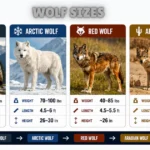
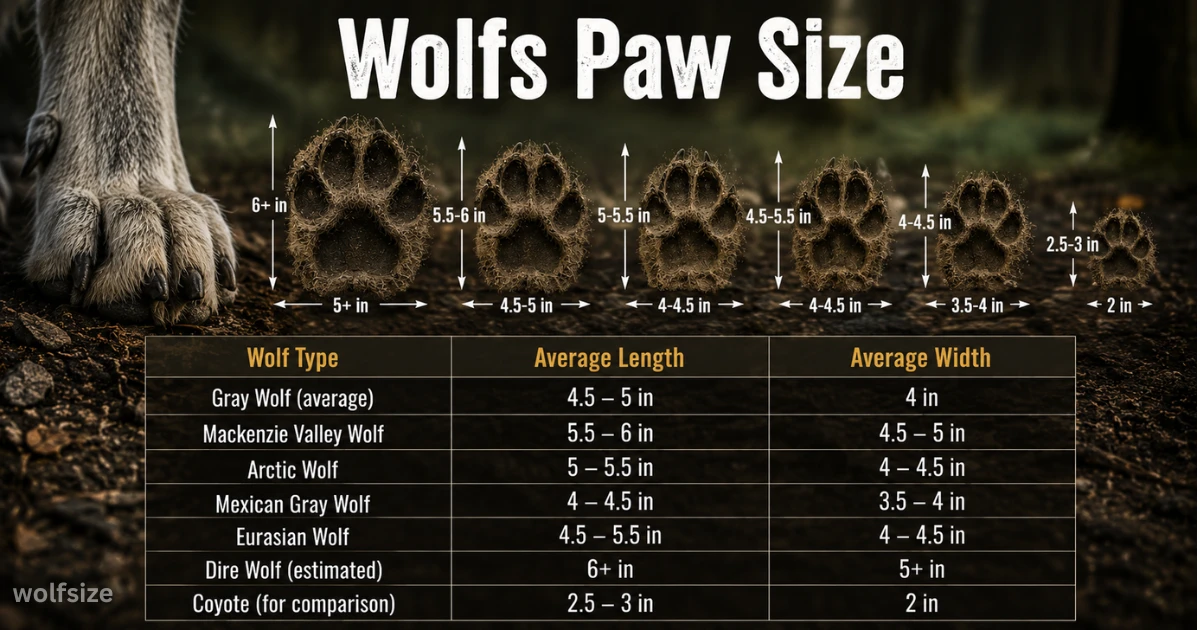
Wolf Paw Size Chart
| Wolf Type | Average Length | Average Width | Notes |
|---|---|---|---|
| Gray Wolf (average) | 4.5 – 5 in | 4 in | Most common baseline measurement |
| Mackenzie Valley Wolf | 5.5 – 6 in | 4.5 – 5 in | Largest living subspecies |
| Arctic Wolf | 5 – 5.5 in | 4 – 4.5 in | Extra fur between pads for cold protection |
| Mexican Gray Wolf | 4 – 4.5 in | 3.5 – 4 in | Smallest North American subspecies |
| Eurasian Wolf | 4.5 – 5.5 in | 4 – 4.5 in | Similar range to North American gray wolves |
| Dire Wolf (estimated) | 6+ in | 5+ in | Extinct; estimate based on fossil body mass |
| Coyote (for comparison) | 2.5 – 3 in | 2 in | About half the size of a wolf print |
More Posts:Great Plains Wolf Size: Weight, Length & Height Explained
Wolf Paw Compared to Human Foot/Hand
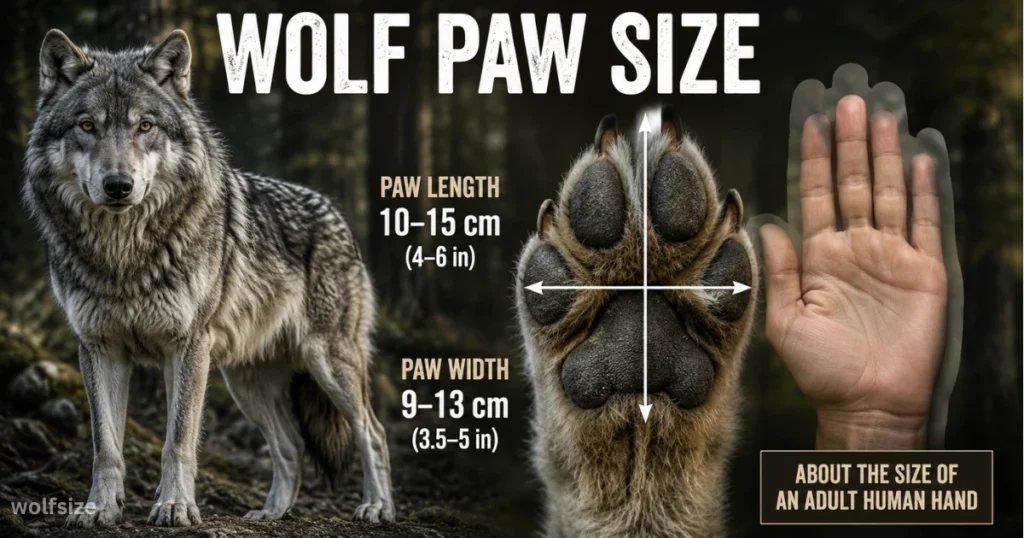
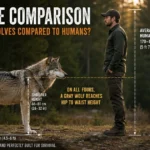
A wolf paw compared to a human foot is close in length but noticeably wider and rounder. Held up next to an adult human hand, a wolf’s front paw print is nearly the same size, palm to fingertip. This comparison helps hikers and trackers get an instant sense of scale without needing a ruler.
Forepaw vs. Hind Paw Size Difference
Wolves have five toes on each forepaw and four toes on each hind paw. The fifth toe on the front foot, called the dewclaw, sits higher up the leg and rarely touches the ground. Because of this, front paws print larger than back paws. Hind prints usually run 15 to 20 percent smaller than the corresponding front print.
Wolf Paw Size by Species
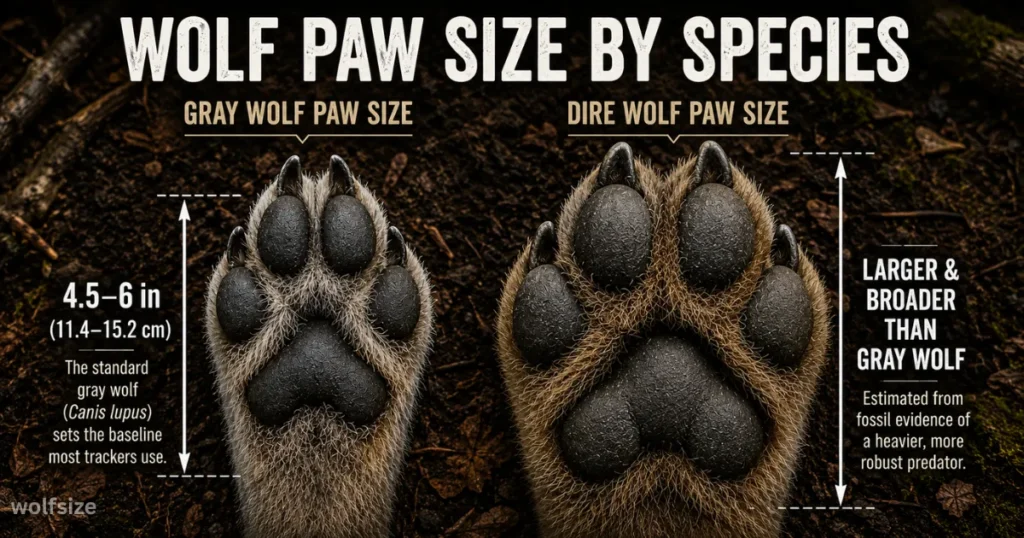
Gray Wolf Paw Size
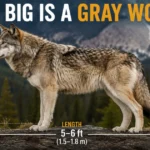
The standard gray wolf (Canis lupus) sets the baseline most trackers use: 4.5 to 6 inches long. This is the most widespread wolf species across North America, Europe, and Asia, so most published measurements come from this group.
Dire Wolf Paw Size
The dire wolf (Aenocyon dirus) was a heavier, more robust predator that went extinct roughly 10,000 years ago. Fossil evidence shows dire wolves were about 20 percent heavier than modern gray wolves, with a stockier build and larger skull.
Their paws are estimated to have been noticeably bigger and broader than a gray wolf’s, built to support significantly more body weight, though exact print measurements are harder to confirm since no living dire wolf tracks exist to study.
Which Wolf Species Has the Largest Paws?
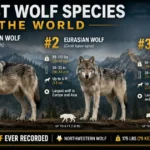
The Mackenzie Valley wolf, also called the Alaskan or Canadian timber wolf, holds the record among living wolves. This massive northern subspecies can leave prints up to 6 inches long, matching its status as one of the biggest wolf subspecies alive today.
How to Read Wolf Track Measurements
When measuring a track in the field, always check the clearest, most defined print rather than the largest-looking one. Mud, snow melt, and loose soil can distort edges and make a print appear bigger than it really is. Measure straight-line length from the top of the toes to the back of the heel pad, then width across the widest point.
More Posts:British Columbia Wolf Size: Complete Weight, Length & Height Guide
Are Wolf Paws Bigger Than Dog Paws?
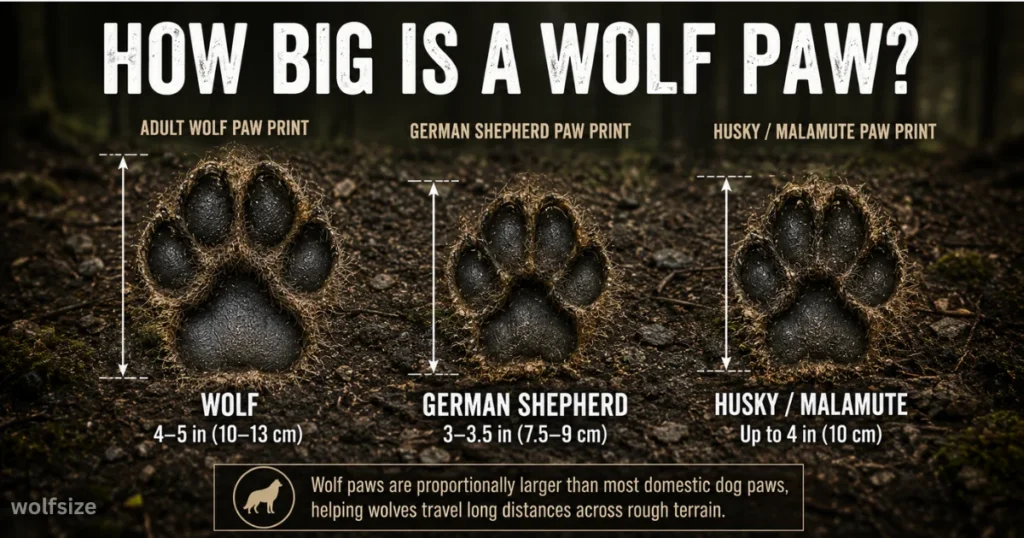
Wolf Paw vs. Large Dog Breeds (German Shepherd, Husky, Malamute)
A German Shepherd’s print usually measures around 3 to 3.5 inches, noticeably smaller than a wolf’s. Huskies and Malamutes come closer, sometimes reaching 4 inches, but still tend to fall short of a full-grown wolf’s track.
The gap comes down to bone structure. Wolves carry proportionally larger paws relative to their body size than most domestic dogs.
Factors That Affect Wolf Paw Size
Age
Pups are born with small, soft paws that grow rapidly during the first year. Paw size increases alongside skeletal growth and doesn’t reach full adult dimensions until the wolf is close to physically mature, usually around one to two years old.
Gender
Male wolves generally carry more body mass than females, and their paws reflect that. Male gray wolves often leave prints slightly longer and wider than female wolves of the same subspecies. This gap mirrors the overall size difference between the sexes.
Species/Subspecies
Paw size varies a lot across the roughly thirty recognized gray wolf subspecies. Northern, cold-climate wolves tend to carry larger paws relative to body size than wolves from warmer regions. This links directly to snow adaptation, which we’ll cover below.
Habitat and Climate
Wolves living in deep snow environments, like the Arctic tundra or northern Canada, have developed proportionally larger paws over generations. A bigger paw spreads weight over more surface area, acting like a built-in snowshoe. Wolves in milder, drier climates don’t face the same evolutionary pressure, so their paws stay comparatively smaller.
FAQ’s About Paw Size
What is the size of a wolf footprint?
A wolf footprint runs about 4 to 6 inches long and 3.5 to 5 inches wide, roughly the size of an adult human hand.
Are wolf paws bigger than dog paws?
Yes. Wolf paws are generally larger and more oval-shaped than even large domestic dog breeds.
Which wolf species has the largest paws?
The Mackenzie Valley wolf has the largest paws of any living wolf subspecies, with prints up to 6 inches long.
How big is a dire wolf’s paw compared to a gray wolf’s?
Dire wolves were heavier and stockier, so their paws are estimated to have been larger and broader than a gray wolf’s paw.
Is a wolf’s paw really the size of a human hand?
Yes, a wolf’s front paw print is close in size to an adult human hand, both in length and general proportion.
Conclusion
Wolf paw size ranges from 4 to 6 inches depending on species, age, sex, and climate, with the Mackenzie Valley wolf topping the list among living wolves and the extinct dire wolf likely surpassing them all. Whether you’re comparing gray wolf paw size to a dog track on a trail or just curious how a wolf stacks up against a human hand, the paw tells a clear story: it’s a tool built for distance, snow, and survival.

Robert Taylor is a content researcher and writer specializing in dimensions, measurements, and size comparison guides. He creates clear, practical content that helps readers understand real-world sizes and measurements with confidence. His work focuses on delivering accurate, easy-to-use dimension information in both U.S. and metric units.