You’ve seen a German Shepherd and thought — this dog looks wild. That thick coat, those pointed ears, that powerful build. It almost looks like a wolf.
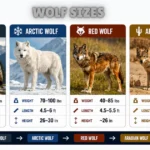
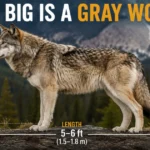
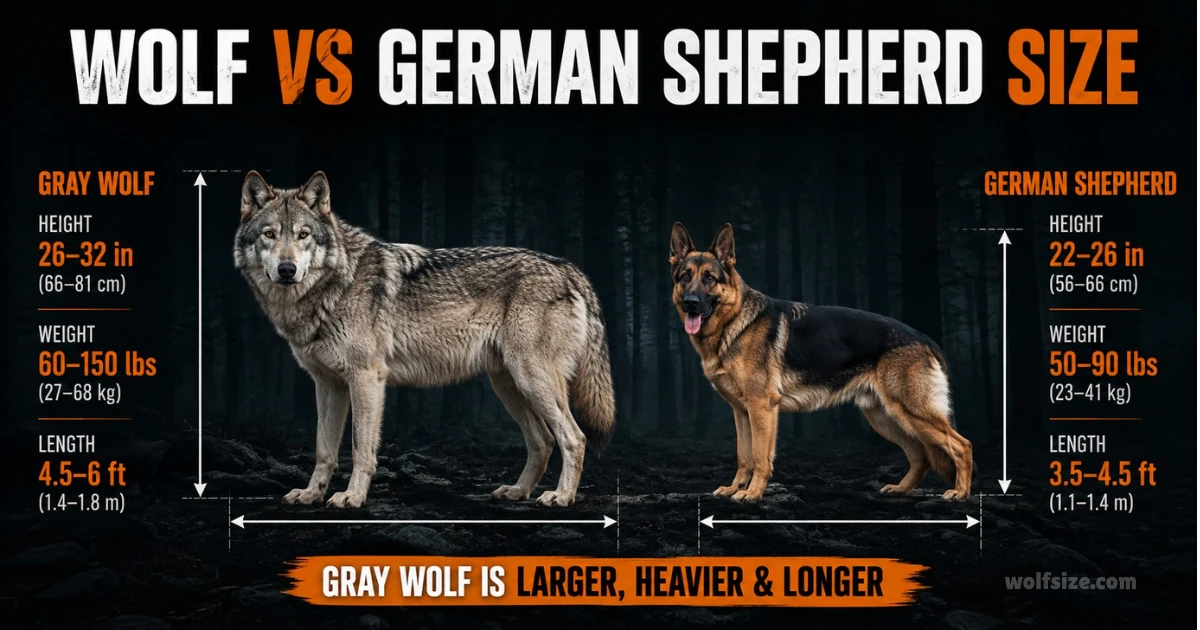
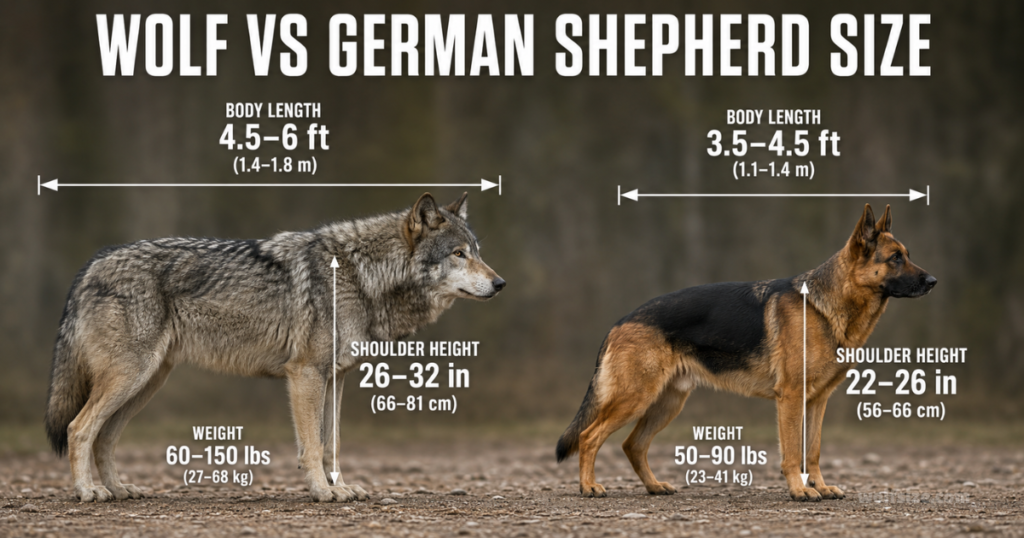
Yes, a gray wolf is significantly larger than a German Shepherd. Adult gray wolves typically stand 26–32 inches tall, weigh 60–150 lbs, and measure up to 6 feet long. In comparison, German Shepherds usually stand 22–26 inches tall, weigh 50–90 lbs, and reach about 4.5 feet in length. Wolves also have larger skulls, stronger jaws, and more powerful builds, making them noticeably bigger and stronger than even the largest German Shepherds.
Size Comparison: Wolf vs German Shepherd
| Measurement | Gray Wolf | German Shepherd |
|---|---|---|
| Height | 26–32 inches | 22–26 inches |
| Weight | 60–150 lbs | 50–90 lbs |
| Body Length | 4.5–6 feet | 3.5–4.5 feet |
Height: How Tall Is a Wolf vs a German Shepherd?
A gray wolf (Canis lupus) stands between 26 and 32 inches at the shoulder.
A German Shepherd (Canis lupus familiaris) reaches 22 to 26 inches.
So at their tallest, a GSD matches the shortest wolf. The average wolf is still taller than the average German Shepherd.
Weight: How Much Does a Wolf Weigh vs a German Shepherd?
Average wolf weight: 70–110 lbs in the wild (males heavier than females).
Average German Shepherd weight: 65–90 lbs for males, 50–70 lbs for females.
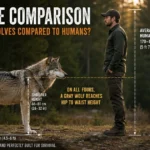
On paper, they seem close. But wolves in cold northern regions — like Alaska and Canada — regularly hit 130–150 lbs. That’s in a completely different weight class than any GSD.
Body Length and Build: Which One Is Physically Larger?
Wolves have longer legs, deeper chests, and a more elongated body frame. Their skeletal structure is built for covering miles of rugged terrain daily — sometimes 30 to 40 miles in a single day.
German Shepherds are athletic and lean, but their frame is noticeably more compact. They were bred for herding and protection, not cross-country endurance pursuit.
More Posts:How Big Is an Eastern Wolf? Size, Weight, Height & Facts – 2026
Why Wolves Are Built Bigger — Biology and Evolution Explained
Wolves evolved for raw survival. They hunt large prey — elk, moose, bison. Taking down an animal that weighs 800 to 1,500 pounds requires real size, power, and endurance. Natural selection over thousands of years favored bigger, stronger wolves.
German Shepherds were shaped by human hands. Selective breeding, which began seriously in the late 1800s in Germany, optimized the GSD for intelligence, obedience, and agility — not maximum size. Captain Max von Stephanitz, who developed the breed, wanted a working dog, not a large one.
That’s why the German Shepherd size vs wolf size comparison always tips the same direction: the wolf wins. It was never bred to be smaller — it simply evolved differently.
How Wild Survival Shaped Wolf Size
In the wild, bigger wolves survive better. A larger body means:
- More muscle mass to take down prey
- Greater fat reserves to survive food shortages
- Better thermoregulation in freezing environments
According to research published in the journal Behavioral Ecology, dominant alpha wolves in a pack are typically the heaviest animals. Size directly links to social rank and reproductive success in wolf packs.
German Shepherd vs Wolf
German Shepherds share about 99.9% of their DNA with wolves. Not a metaphor — literal genetic fact confirmed by DNA analysis.
That shared ancestry shows up in ways you can see and measure.
Shared DNA: Why German Shepherds Look So Much Like Wolves
The GSD is consistently ranked among the most wolf-like dog breeds in terms of physical appearance. Pointed ears, a sloped back, a bushy tail, a dense double coat, and a deep chest — all of these traits echo the gray wolf directly.
This is why GSD mixes are sometimes mistaken for wolf hybrids. And why the German Shepherd wolf size comparison draws so much curiosity. They look related because they are related — just separated by thousands of years of domestication.
Pack Mentality, Loyalty, and Social Structure
Both wolves and German Shepherds are pack-oriented animals that thrive on social connection.
Wolves live in tight family units where every member has a role. German Shepherds show the same instinct in domestic life — bonding deeply with their human family, looking to a leader, and becoming anxious when isolated.
This shared social wiring is why German Shepherds train so well and why they bond so intensely with their owners. The pack instinct is one of the most preserved wolf traits in the breed.
More Posts:Wolf Size Comparison: How Large Are Wolves Compared to Humans? 2026
Beyond Size: Key Differences Between a Wolf and a German Shepherd
Size is just one dimension. These two animals differ in fundamental ways.
Bite Force, Strength, and Endurance: Wolf vs German Shepherd
| Trait | Wolf | German Shepherd |
|---|---|---|
| Bite Force | ~400 PSI | ~238 PSI |
| Top Speed | 35–40 mph | 30 mph |
| Daily Travel | 30–40 miles | 3–8 miles (typical) |
| Endurance | Exceptional | Good |
A wolf is a wild apex predator. A German Shepherd is a loyal working partner. Same ancestor. Very different animal.
FAQs: Wolf vs German Shepherd Size
Is a Wolf Bigger Than a German Shepherd?
Yes. Wolves are larger in height, weight, and body length. A gray wolf stands 26–32 inches tall and can weigh up to 150 lbs. A German Shepherd typically stands 22–26 inches and weighs 50–90 lbs.
How Much Bigger Is a Wolf Than a German Shepherd?
On average, a wolf is about 4–6 inches taller, 30–60 lbs heavier, and 1–1.5 feet longer in body length than a German Shepherd.
Can a German Shepherd Fight Off a Wolf?
In a direct confrontation, a wolf would almost certainly overpower a German Shepherd. Wolves have nearly double the bite force, greater size, and are built for combat hunting. This is not a fair match.
Do German Shepherds Look Like Wolves?
Yes — more than most breeds. They share pointed ears, a dense double coat, a similar facial structure, and a sloped back. This resemblance comes from their shared genetic ancestry with 99.9% shared DNA.
What Dog Breed Is Closest in Size to a Wolf?
The Great Dane, Irish Wolfhound, and Alaskan Malamute come closest in raw size. Among wolf-like breeds, the Czechoslovakian Wolfdog and Saarloos Wolfdog are the most similar in both appearance and size.
Could a German Shepherd Survive in the Wild Like a Wolf?
Unlikely. Thousands of years of domestication have changed the GSD’s instincts, digestive system, and ability to hunt large prey independently. Even feral dogs struggle to survive where wolves thrive.
The Final Verdict
Wolves are bigger than German Shepherds — consistently, measurably, and significantly.
A gray wolf outweighs the average GSD by 30–60 lbs, stands taller, stretches longer, bites harder, and runs farther.
But the German Shepherd is not a lesser animal — it’s a different one. Bred for intelligence, loyalty, and partnership with humans, the GSD took wolf DNA and shaped it into the world’s most versatile working dog.
One is built for the wild. One is built for your side.
Both deserve respect.

Robert Taylor is a content researcher and writer specializing in dimensions, measurements, and size comparison guides. He creates clear, practical content that helps readers understand real-world sizes and measurements with confidence. His work focuses on delivering accurate, easy-to-use dimension information in both U.S. and metric units.