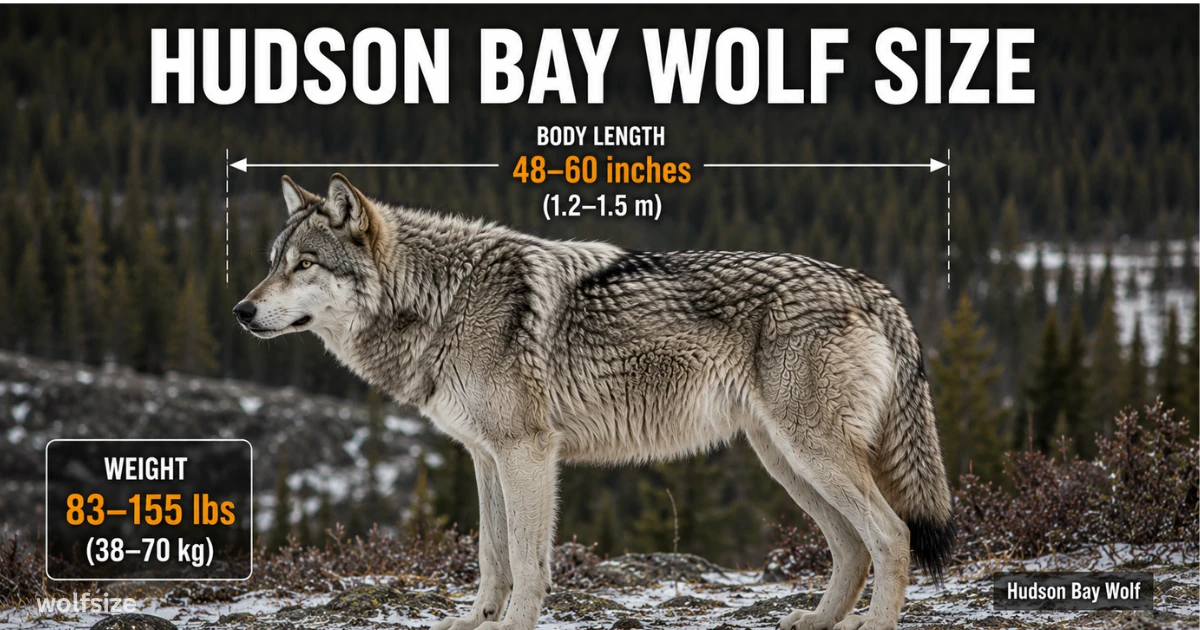
The Hudson Bay wolf is a large gray wolf subspecies that typically weighs between 83–155 pounds (38–70 kg). It stands about 28–36 inches (71–91 cm) tall at the shoulder and measures roughly 48–60 inches (1.2–1.5 meters) in length from nose to tail.
Native to the coastal region of northern Canada, the Hudson Bay wolf is often confused with its lighter-colored cousin, the Arctic wolf. But size, build, and skull shape set the two apart.
This guide breaks down every number you need, plus the science behind why this wolf grows the way it does.
Hudson Bay Wolf Size at a Glance
Average Hudson Bay Wolf Weight (lbs & kg)
A full-grown Hudson Bay wolf weighs 83 to 155 pounds (38 to 70 kg). That’s a wide range, and it comes down to sex, age, and how much prey is available in a given season.
Average Hudson Bay Wolf Length and Shoulder Height
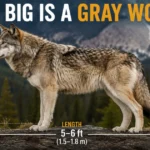
Nose to tail, this wolf measures 48 to 60 inches (120 to 150 cm). At the shoulder, it stands 28 to 36 inches tall (70 to 90 cm). Its thick winter coat can make it look bulkier than it actually is — guard hairs along the back and neck add several inches of visual height without adding real bone or muscle.
Hudson Bay Wolf Size by Gender
Male Hudson Bay Wolf Size
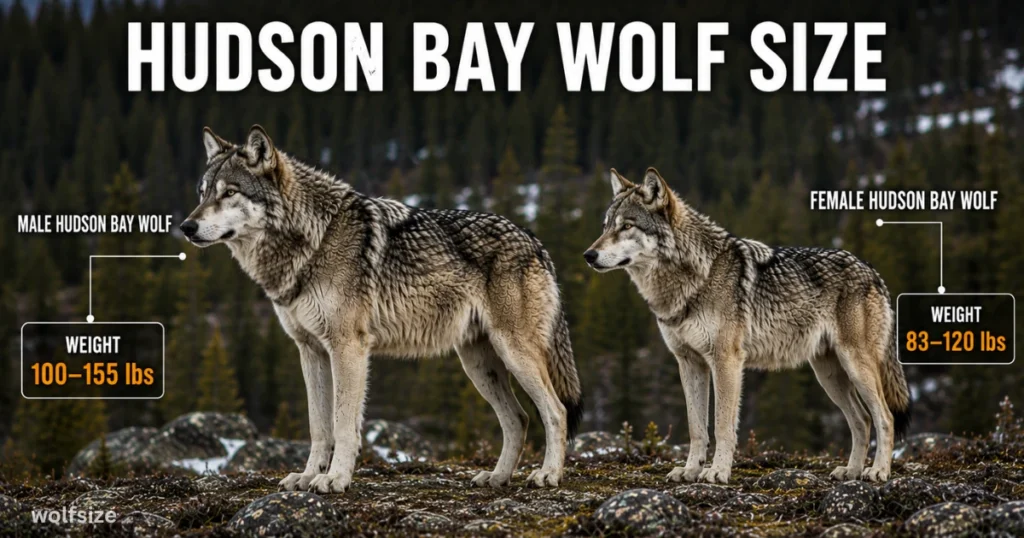
Males run larger across every measurement. A typical male tips the scale at 100 to 155 pounds and reaches the upper end of the height and length ranges. This pattern, where males outweigh females by 15 to 20%, is common across nearly all gray wolf subspecies, not just this one.
Female Hudson Bay Wolf Size
Female Hudson Bay wolves are lighter and slightly shorter, usually falling between 83 and 120 pounds. They still hunt the same large prey as males and play an equal role in the pack, but their frame is built leaner, likely to reduce energy costs during pregnancy and nursing.
More Posts:Baffin Island Wolf Size: Weight, Height, and Length Explained
Hudson Bay Wolf Size Compared to Other Wolves
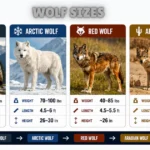
Hudson Bay Wolf vs Arctic Wolf Size
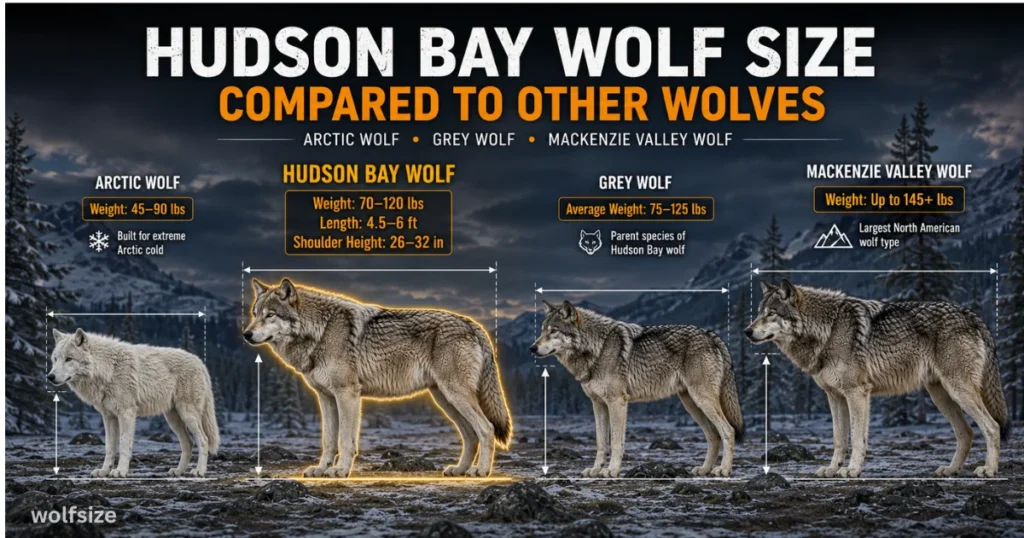
Both wolves share pale, white-to-cream coats, but the Arctic wolf is generally smaller and more compact, built for extreme cold with shorter legs and a rounder skull. The Hudson Bay wolf has a flatter skull and a slightly longer frame, which is one of the clearest ways researchers tell the two apart in the field.
Hudson Bay Wolf vs Grey Wolf Size
“Grey wolf” is actually the parent species that includes the Hudson Bay wolf as one subspecies among many. Compared to the broader grey wolf average of 75 to 125 pounds, the Hudson Bay wolf runs on the heavier end, thanks to a diet built around large ungulates like caribou and moose.
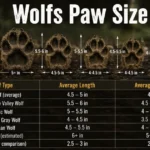
Hudson Bay Wolf vs Mackenzie Valley Wolf Size
The Mackenzie Valley wolf (also called the Northwestern wolf) is the true heavyweight of North America, sometimes topping 145 pounds with males reaching even higher. The Hudson Bay wolf closely resembles it in coloring and shape but stays noticeably smaller in both length and overall bulk.
Hudson Bay Wolf Size Compared to Humans and Dogs
Hudson Bay Wolf vs Average Human Height
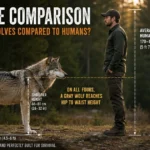
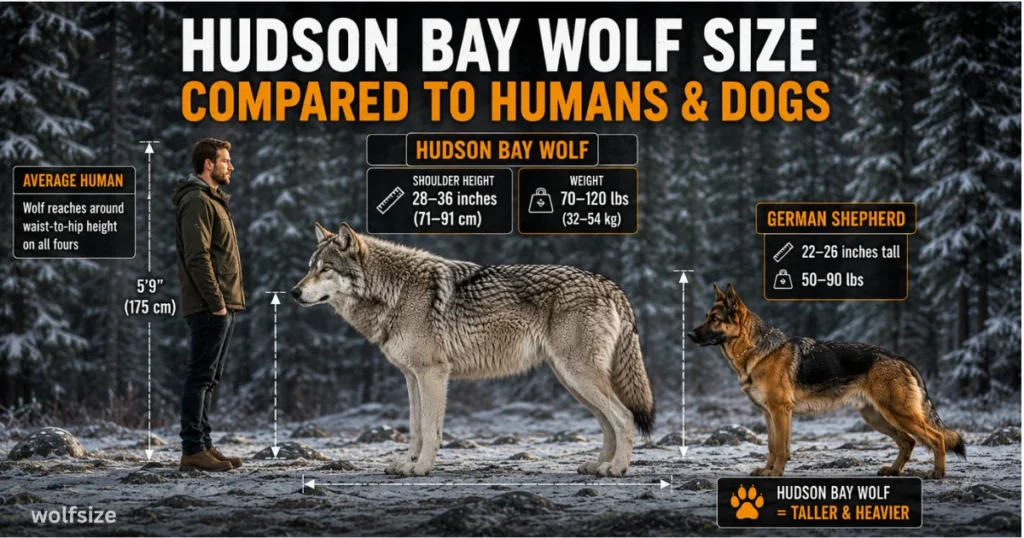
At 28 to 36 inches tall at the shoulder, a standing Hudson Bay wolf reaches roughly waist-to-hip height on an average adult. On all fours it looks smaller than a person, but rear up or stretch its neck, and its head can approach chest height on a shorter adult.
Hudson Bay Wolf vs Large Dog Breeds
Compared to a German Shepherd (usually 22 to 26 inches tall, 50 to 90 pounds), the Hudson Bay wolf is both taller and considerably heavier.
Even next to a Great Dane, one of the tallest dog breeds, the wolf holds its own in raw body weight, packing more muscle into a leaner, more athletic frame built for long-distance hunting rather than size alone.
More Posts:Ethiopian Wolf Size: How Big Is This Rare Canid?
FAQ’s About Hudson Bay Wolf Size
How much does a Hudson Bay wolf weigh?
A Hudson Bay wolf weighs 83 to 155 pounds (38 to 70 kg), with males on the heavier end.
How long is a Hudson Bay wolf from nose to tail?
It measures 48 to 60 inches (120 to 150 cm) long, including the tail.
How tall is a Hudson Bay wolf at the shoulder?
Shoulder height ranges from 28 to 36 inches (70 to 90 cm).
Is the Hudson Bay wolf bigger than a Grey wolf?
Yes, it sits above the average Grey wolf range, thanks to a diet of large northern prey.
What is the largest Hudson Bay wolf ever recorded?
Documented cases place the heaviest individuals near 155 pounds, usually adult males after a large kill.
Conclusion
The Hudson Bay wolf ranks among the larger gray wolf subspecies in North America, built heavy by a cold climate and a diet of caribou and moose. Its size sits close to the Mackenzie Valley wolf but stays a step behind, while easily outweighing the Arctic wolf it’s so often mistaken for. Whether you’re comparing it to another subspecies, a dog breed, or a person, the numbers tell a clear story: this is a wolf shaped by its northern home.

Robert Taylor is a content researcher and writer specializing in dimensions, measurements, and size comparison guides. He creates clear, practical content that helps readers understand real-world sizes and measurements with confidence. His work focuses on delivering accurate, easy-to-use dimension information in both U.S. and metric units.