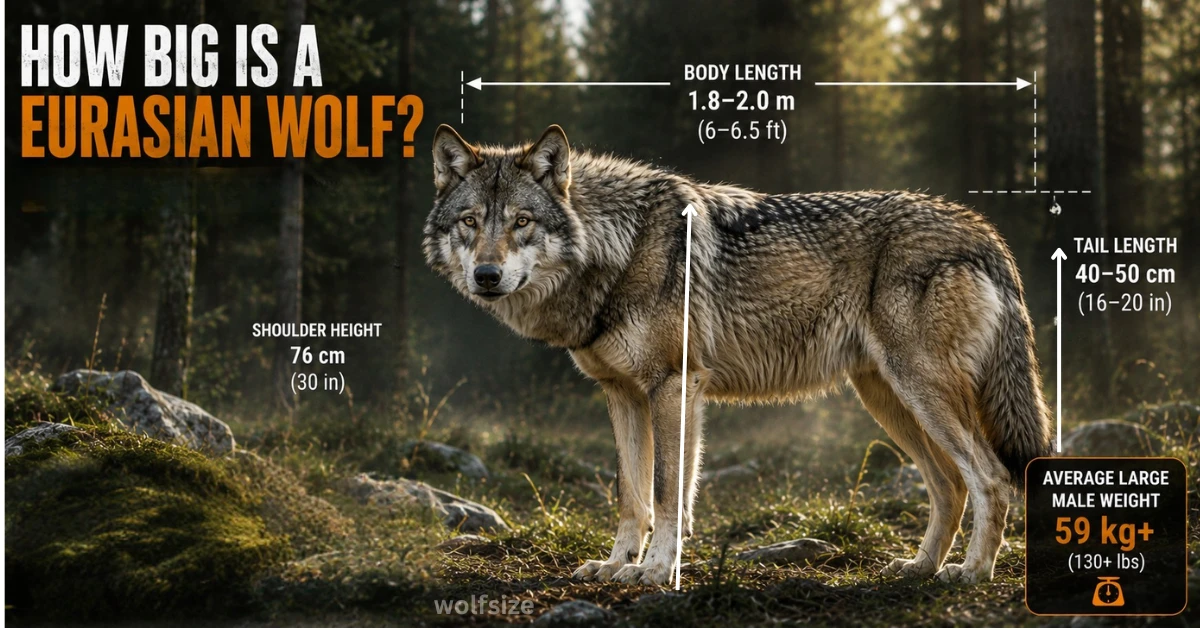
An adult Eurasian wolf can weigh more than 130 pounds (59 kg), stand around 30 inches (76 cm) tall at the shoulder, and measure over 6 feet (1.8 m) from nose to tail.
The Eurasian wolf is the largest gray wolf subspecies in the world, known for its powerful build, long body, and ability to thrive across vast regions of Europe and Asia.
This guide breaks down its real size, backed by field data, and shows how it stacks up against other wolves, dogs, and even humans
How Big Is a Eurasian Wolf?
A Eurasian wolf typically weighs 70 to 130 pounds (32 to 59 kg) and stands 26 to 33 inches tall at the shoulder. Nose to tail, it measures roughly 41 to 63 inches (105 to 160 cm).
This subspecies, known by its scientific name Canis lupus lupus, holds the title of largest gray wolf subspecies in the world. Its close relatives, like the Arctic wolf and Indian wolf, are noticeably smaller in most cases.
Eurasian wolf size isn’t fixed. It shifts based on three main things: sex, geography, and prey availability. A wolf roaming central Russia’s boreal forests often outweighs one living in Western Europe’s fragmented woodlands, simply because colder climates and bigger prey favor a bulkier body.
Eurasian Wolf Weight by Sex
Male Eurasian wolves are heavier, averaging 88 pounds, while females average around 71 pounds.
Heaviest Recorded Eurasian Wolf
The largest confirmed gray wolf on record was killed in Romania and weighed 158 pounds. That’s roughly the size of an adult human male, packed into a lean, muscular hunting body built for endurance, not bulk.
Males grow larger mainly to compete for breeding rights and to take down bigger prey like moose and red deer during pack hunts.
| Measurement | Male | Female |
|---|---|---|
| Weight | 68–110 lbs | 51–88 lbs |
| Shoulder Height | ~30 in | ~28 in |
| Body Length | 45–63 in | 43–61 in |
| Tail Length | 14–20 in | 13–19 in |
More Posts:How Big Is an Eastern Wolf? Size, Weight, Height & Facts – 2026
Eurasian Wolf Size Compared to Other Wolves and Dogs
Wolf-to-Wolf Comparison
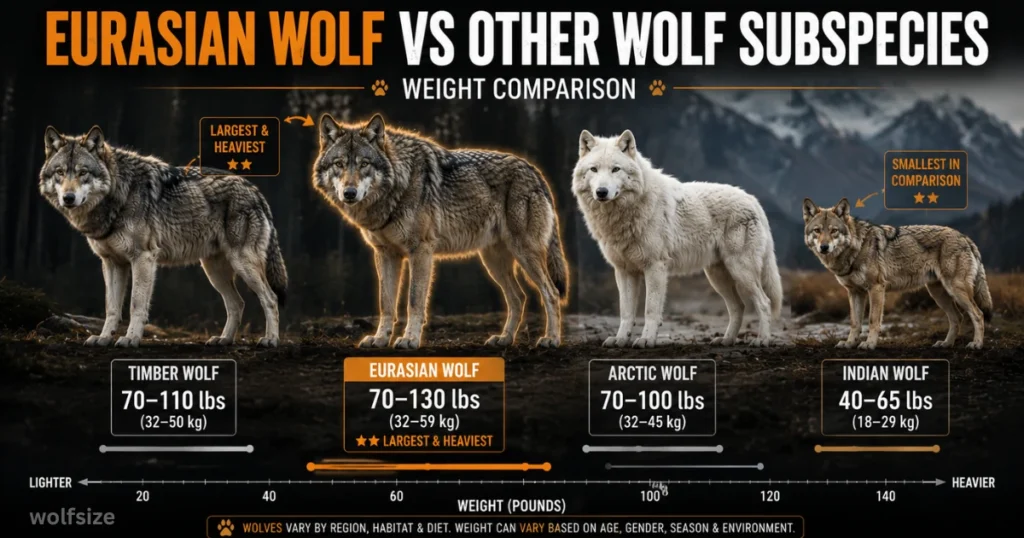
- Eurasian wolf: 70–130 lbs, the heavyweight of the group
- Arctic wolf: 70–100 lbs, similar length but shorter legs
- Timber wolf (North American): 70–110 lbs, close in size but bulkier fur
- Indian wolf: 40–65 lbs, noticeably smaller and more slender
Eurasian Wolf vs. Large Dog Breeds
A Eurasian wolf is longer and taller than a German Shepherd (which averages 50–90 lbs) and comparable in height to a Great Dane, though far leaner and more muscular. Wolves carry their weight differently. Their bodies are built for long-distance travel, not size for its own sake.
Eurasian Wolf vs. Human Height
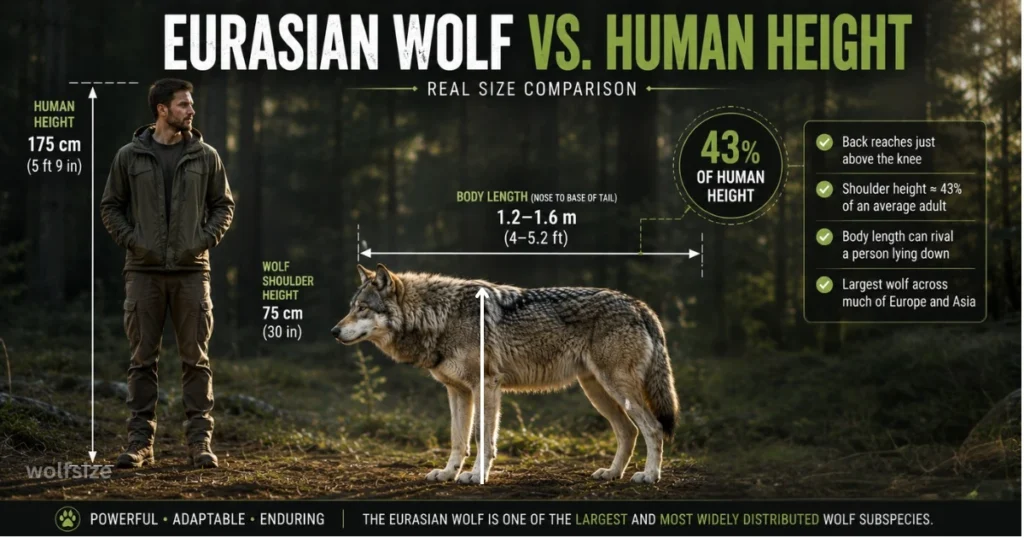
At the shoulder, a Eurasian wolf reaches about 43% of average human height. Picture a wolf standing next to an adult, its back reaching just above the knee, but with a body length that can rival a person lying down.
Why Regional Size Varies
Wolves in Russia and Northern Europe tend to run larger than those in Western and Southern Europe. Colder climates favor bigger bodies that retain heat more efficiently, a pattern biologists call Bergmann’s Rule. Prey size plays a role too. Regions with moose and reindeer produce heavier wolves than regions where roe deer and hares dominate the menu.
More Posts:Maned Wolf Size: Height, Weight, Length & How Big They Really Get
FAQs About Eurasian Wolf Size
How big is a Eurasian wolf compared to a regular gray wolf?
The Eurasian wolf is the largest recognized subspecies of gray wolf, often outweighing other gray wolf populations by 10 to 20 pounds on average.
What is the average weight of a Eurasian wolf?
Adult Eurasian wolves average 70 to 130 pounds, with males typically heavier than females.
How tall does a Eurasian wolf get at the shoulder?
Eurasian wolves stand about 26 to 33 inches tall at the shoulder, roughly knee-height on an adult person.
Is the Eurasian wolf the largest wolf subspecies in the world?
Yes, the Eurasian wolf (Canis lupus lupus) is widely recognized as the largest gray wolf subspecies.
Do male and female Eurasian wolves differ much in size?
Yes, males average 88 pounds while females average 71 pounds, a clear case of sexual dimorphism.
What is the biggest Eurasian wolf ever recorded?
The heaviest confirmed individual weighed 158 pounds, recorded in Romania.
Conclusion
Eurasian wolf size comes down to a mix of biology and environment. Males run bigger than females, northern populations outsize southern ones, and diet shapes growth from the pup stage onward. As the largest gray wolf subspecies, this animal remains one of the most physically impressive predators still roaming Europe and Asia today.

Robert Taylor is a content researcher and writer specializing in dimensions, measurements, and size comparison guides. He creates clear, practical content that helps readers understand real-world sizes and measurements with confidence. His work focuses on delivering accurate, easy-to-use dimension information in both U.S. and metric units.