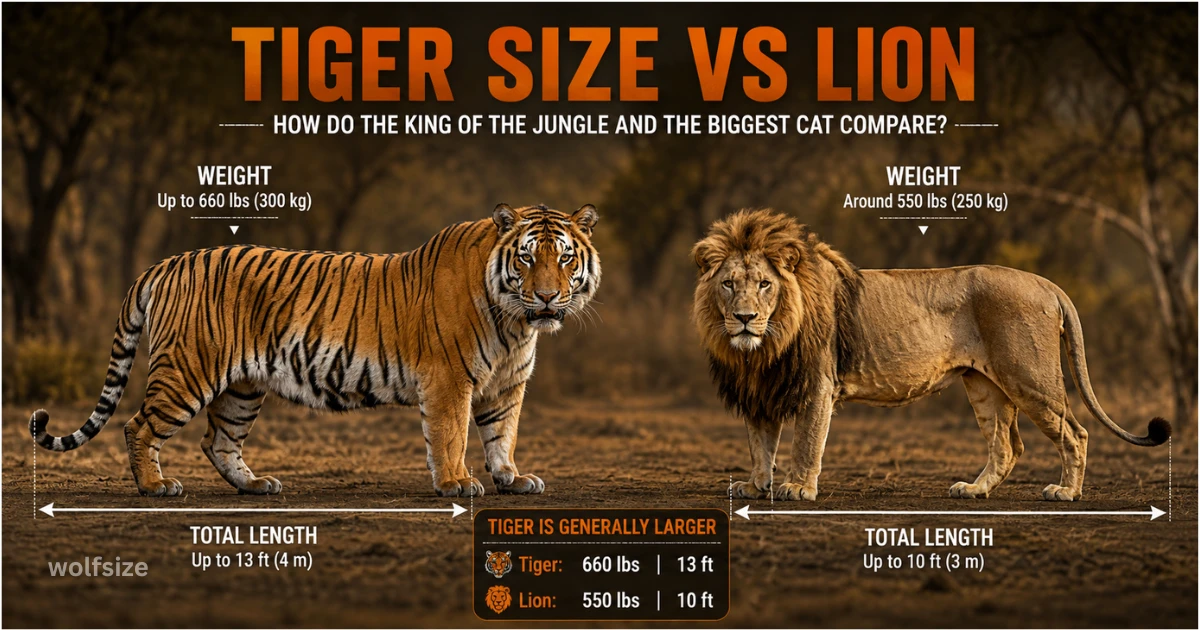
The tiger is generally larger than the lion. A full-grown male tiger can weigh up to 660 pounds (300 kg) and reach about 13 feet (4 meters) in total length, while a large male lion can weigh around 550 pounds (250 kg) and measure up to 10 feet (3 meters) long.
Tigers and lions are the two largest members of the Panthera family. Both are icons of raw power. But when you put a tiger size vs lion side by side, the numbers tell a clear story — and there’s more to it than just weight.
Tiger Size vs Lion — Quick Comparison Overview
| Trait | Tiger | Lion |
|---|---|---|
| Weight | Up to 660 lbs | Up to 550 lbs |
| Length | Up to 13 ft | Up to 10 ft |
| Shoulder Height | ~3.5 ft | ~4 ft |
| Bite Force | 1,000–1,200 PSI | ~650 PSI |
| Top Speed | 50–60 mph | ~50 mph |
The Short Answer — Tiger Size vs Lion?
Tigers are the largest wild cats on Earth. The Siberian tiger, also called the Amur tiger, is the biggest subspecies of all. It regularly outweighs lions by 100 pounds or more.
Lion Size vs Tiger
Tiger Weight vs Lion Weight
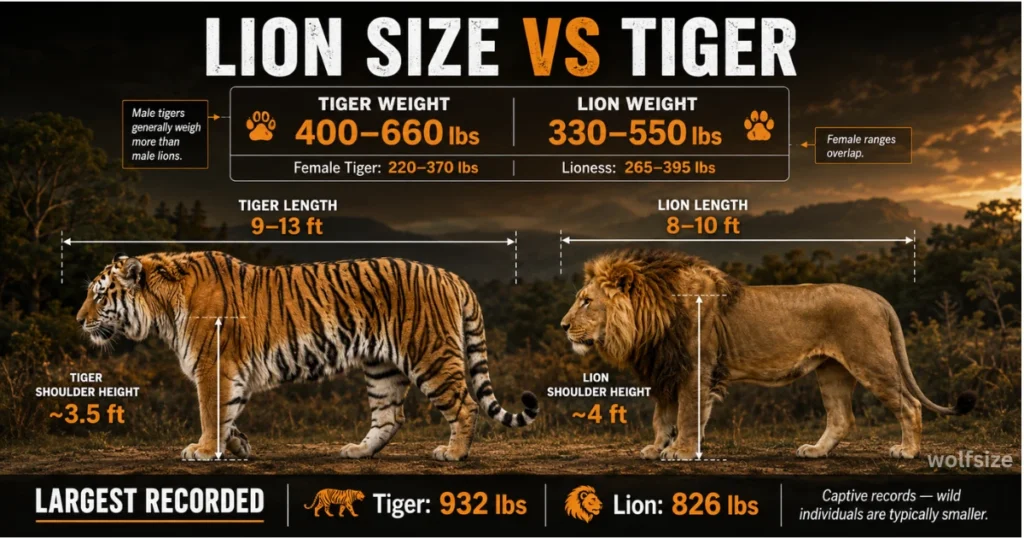
A male Siberian tiger typically weighs between 400 and 660 pounds. A male African lion usually falls between 330 and 550 pounds. Female tigers and lionesses follow the same pattern — tigresses are heavier, often weighing 220 to 370 pounds compared to a lioness’s 265 to 395 pounds, though this can vary by region and prey availability.
Tiger Length vs Lion Length (Nose to Tail)
Length is where the gap widens the most. Male tigers can reach 9 to 13 feet from nose to tail tip. Male lions max out around 8 to 10 feet. That extra length comes from a longer spine and a more stretched-out body frame, built for stalking prey through dense cover.
Shoulder Height Comparison
Here’s a twist: lions are actually taller at the shoulder. A male lion stands about 4 feet tall, while a tiger stands closer to 3.5 feet. This is because lions have proportionally longer legs, useful for spotting prey over tall grass on the open savanna.
Largest Tiger and Lion Ever Recorded
The largest tiger on record was a captive Siberian tiger weighing an astonishing 932 pounds. The largest lion ever recorded, also in captivity, weighed 826 pounds. Wild individuals rarely reach these extremes, but the records confirm the same pattern seen in the wild: tigers out-mass lions at the top end.
More posts:Mountain Lion Size: Weight, Height, Length & Size Comparison
Lion vs Tiger Size
Muscle Mass and Body Structure
Tigers carry more muscle mass relative to their frame, especially in the front legs and shoulders. This build helps them grapple and pin down large prey solo. Lions, by contrast, have a stockier, more compact build suited for short bursts of teamwork rather than one-on-one takedowns.
Bite Force Comparison
A tiger’s bite force measures roughly 1,000 to 1,200 PSI — among the strongest of any land predator. A lion’s bite comes in lower, around 650 PSI, though some estimates push closer to 1,000 PSI. Tigers also carry the longest canine teeth of any big cat, reaching up to 4 inches.
Speed and Agility by Size
Despite the size difference, both cats hit similar top speeds of around 50 mph. Tigers can leap 30 feet horizontally and 16 feet vertically, while lions leap slightly farther horizontally (36 feet) but not as high. Bigger doesn’t always mean slower — both cats are explosive sprinters over short distances.
Why Tigers Are Bigger Than Lions
Solitary Hunting vs Pride Hunting and Body Size
Tigers are solitary hunters. Every kill depends on one animal’s strength, so evolution favored a bigger, more powerful body.
Lions hunt in prides, splitting the workload among several lionesses. Because the group shares the effort, individual lions didn’t need to grow as large to succeed.
Habitat and Prey Size Influence
Siberian tigers live in the freezing forests of the Russian Far East, where prey like elk and wild boar is scattered and tough to bring down. A larger body helps a lone tiger overpower bigger animals.
Lions roam open grasslands in sub-Saharan Africa, where prey like zebra and wildebeest is more plentiful and easier to hunt as a team.
More posts:Siberian Tiger Size: How Big Does This Giant Cat Really Get?
Tiger Size vs Lion by Subspecies
Siberian Tiger vs African Lion Size
This is the biggest size gap of any matchup. The Siberian tiger, the largest tiger subspecies, can outweigh an African lion by well over 100 pounds and stretch several feet longer.
Bengal Tiger vs Asiatic Lion Size
The Bengal tiger, the most numerous tiger subspecies, typically weighs 160 to 230 kg (350–500 lbs) — very close to lion weight ranges. The Asiatic lion, found only in India’s Gir Forest, is slightly smaller than its African cousin, making this the closest matchup in the big cat world.
Female Tiger Size vs Female Lion Size
Most comparisons focus on males, but female size matters too. A tigress generally weighs 220 to 370 pounds, while a lioness typically weighs 265 to 395 pounds. In some cases, a healthy lioness can actually outweigh a smaller tigress — proof that “tiger size vs lion” isn’t always a one-sided story once you factor in gender and subspecies.
More Posts:Black Bear Size: How Big Is a Black Bear? Weight, Height & Length
FAQs — Tiger Size vs Lion
Is a tiger really bigger than a lion?
Yes. Tigers are heavier and longer than lions on average, with the Siberian tiger being the largest of all big cats.
How much heavier is a tiger than a lion?
A male tiger typically outweighs a male lion by about 100 to 150 pounds, depending on subspecies.
Which is taller, a lion or a tiger?
The lion is taller at the shoulder, standing around 4 feet compared to a tiger’s 3.5 feet.
What is the biggest tiger or lion ever recorded?
The largest tiger on record weighed 932 pounds; the largest lion weighed 826 pounds — both in captivity.
Do female tigers outweigh male lions?
Rarely. Male lions are usually heavier than female tigers, though a large tigress can come close.

Robert Taylor is a content researcher and writer specializing in dimensions, measurements, and size comparison guides. He creates clear, practical content that helps readers understand real-world sizes and measurements with confidence. His work focuses on delivering accurate, easy-to-use dimension information in both U.S. and metric units.