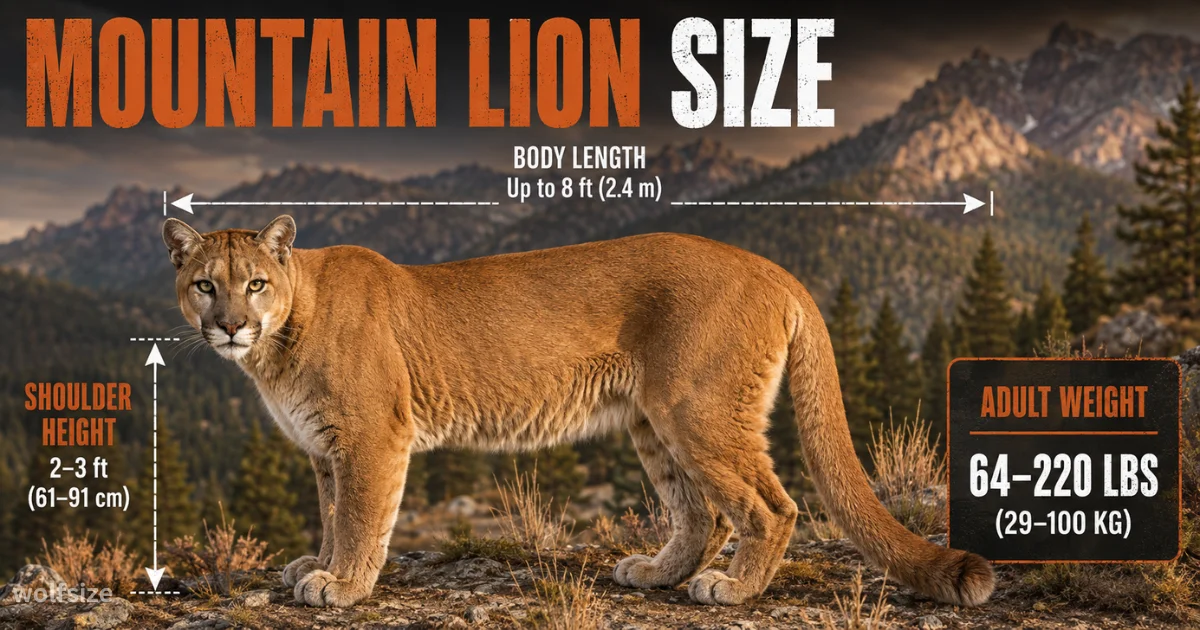
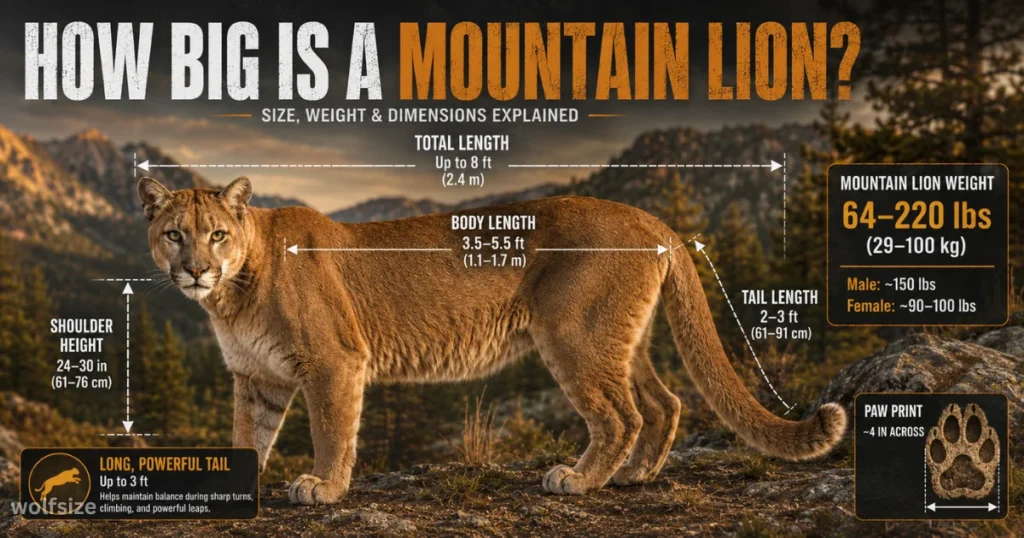
A full-grown mountain lion stands about 2–3 feet (61–91 cm) tall at the shoulder and can reach up to 8 feet (2.4 meters) in total length from nose to tail. This makes it one of the largest wild cats in the Americas, although it is not classified as a true big cat.
This guide breaks down every part of mountain lion size — height, weight, length, and how it stacks up against humans, house cats, and other predators.
How Big Is a Mountain Lion?
Mountain Lion Height and Length
At the shoulder, mountain lions stand between 24 and 30 inches. That’s roughly waist-high on an average adult.
Including the tail, a mountain lion can measure up to 8 feet from nose to tip. The body alone typically runs 3.5 to 5.5 feet, with the tail adding another 2 to 3 feet. This long, muscular tail acts as a counterbalance during sharp turns and big leaps.
Mountain Lion Weight (Average and Range)
Mountain lion weight ranges from 64 to 220 pounds, with males consistently outweighing females. A typical adult male tips the scale around 150 pounds, while females average closer to 90 to 100 pounds.
Despite their size, mountain lions stay lean. Their bodies are built for stealth, not bulk — they need to move silently through brush to stalk prey like deer.
Mountain Lion Paw and Tail Size
A mountain lion’s paw print measures close to 4 inches across, larger than most house cats or even mid-sized dogs. The paws are round and asymmetrical, and claws rarely show in tracks since they stay retracted while walking.
The tail alone can reach 3 feet long — nearly half the length of a human adult.
More Posts:Tiger Size vs Lion: Weight, Height, Length & Size Comparison
Mountain Lion Size vs. Human
How Tall Is a Mountain Lion Compared to a Human?
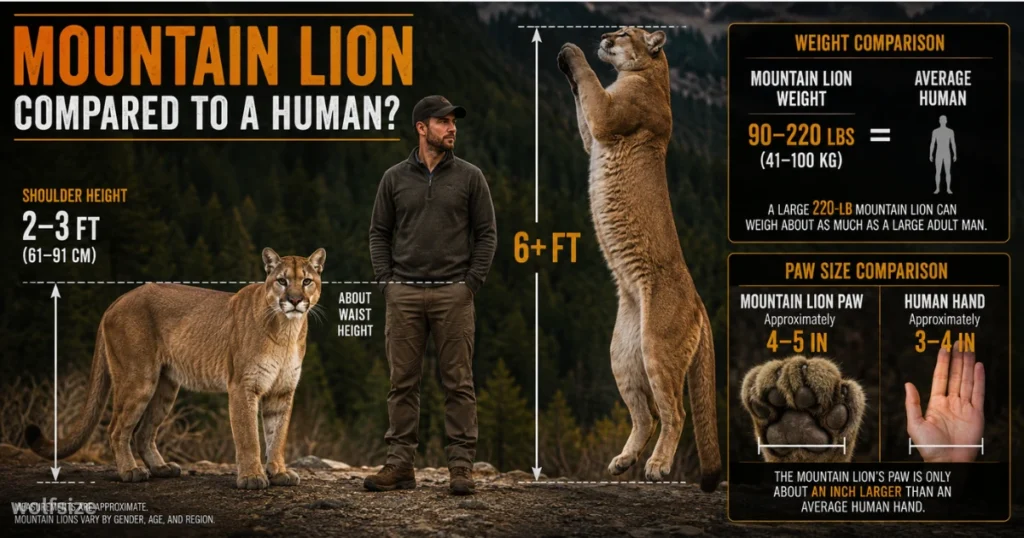
Standing on all fours, a mountain lion reaches about waist height on an average adult human. But rear up on hind legs, and that changes fast — a mountain lion can tower well past six feet, taller than most people.
Mountain Lion Weight vs. Average Human Weight
At the upper end, a 220-pound mountain lion weighs as much as a large adult male, or roughly the weight of a washing machine. Even a smaller female mountain lion, at 90 pounds, can match a mid-sized teenager.
A mountain lion’s paw size is only about an inch bigger than an average human hand.
Mountain Lion Size Compared to Other Animals
Mountain Lion vs. Bobcat Size
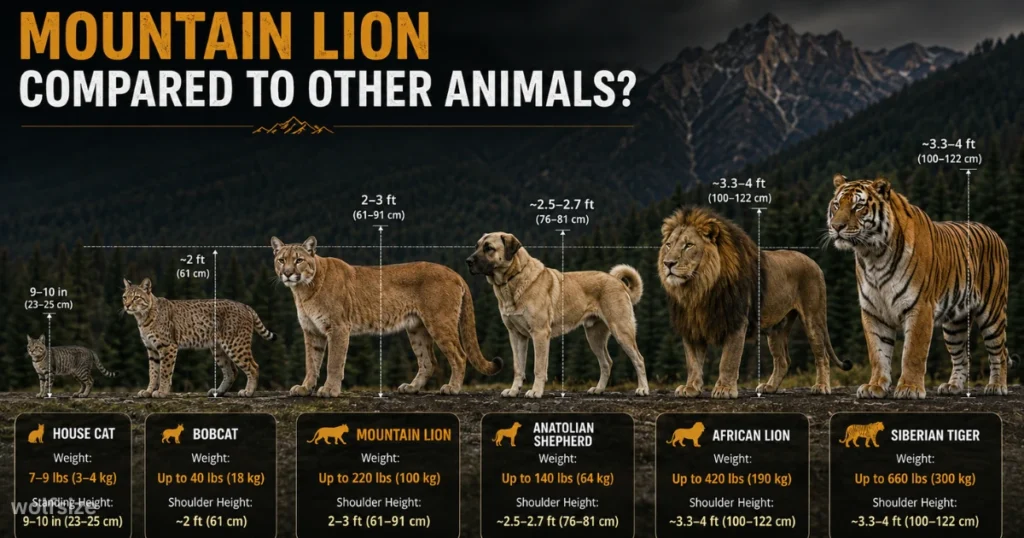
A bobcat stands about 2 feet tall and weighs up to 40 pounds — roughly a third the size of a mountain lion. Bobcats are stocky and compact; mountain lions are long and lean by comparison.
Mountain Lion vs. House Cat Size
The average house cat stands 9 to 10 inches tall and weighs 7 to 9 pounds. It would take nearly 10 house cats stacked in weight to equal one adult mountain lion.
Mountain Lion vs. Dog Size
Small dog breeds, like Chihuahuas, barely reach a mountain lion’s leg height. Even large working breeds, such as the Anatolian Shepherd (up to 140 pounds), come close in weight but still fall short of a big male mountain lion.
Mountain Lion vs. Lion and Tiger Size
An African lion can weigh up to 420 pounds, and a Siberian tiger can top 660 pounds — roughly two to three times heavier than the largest mountain lion.
More posts:Siberian Tiger Size: How Big Does This Giant Cat Really Get?
Male vs. Female Mountain Lion Size
Do Male Mountain Lions Get Bigger Than Females?
Yes. Male mountain lions are noticeably larger, with broader skulls, thicker necks, and heavier builds. Males average 125 to 220 pounds, while females typically weigh 65 to 140 pounds. This size gap, known as sexual dimorphism, helps males compete for territory and mates.
Size Differences by Region and Subspecies
Mountain lion size shifts by geography too. Cats in colder, northern regions (like Canada and the western U.S.) tend to run larger than those near the equator, following a biological pattern called Bergmann’s Rule, where larger body size helps retain heat in cooler climates.
South American subspecies are often smaller and lighter than their North American relatives.
What Affects Mountain Lion Size?
Diet and Prey Availability
Mountain lions rely heavily on deer as their primary food source. In areas with abundant deer populations, mountain lions tend to grow larger and heavier. Where prey is scarce, cats stay leaner out of necessity, not genetics.
Age and Growth Stages
Cubs are born weighing about 1 pound and grow quickly, reaching near-adult size by 12 to 18 months. Full physical maturity, including muscle mass and skull growth, isn’t complete until around 2 to 3 years old.
The Largest Mountain Lion Ever Recorded
The heaviest verified mountain lion on record weighed over 275 pounds, far above the species’ typical range. Cases like this are rare outliers, usually tied to exceptional prey availability and a lack of competition in that territory.
More Posts:Sun Bear Size: How Big Is the World’s Smallest Bear?
FAQs About Mountain Lion Size
How Big Is a Mountain Lion?
A mountain lion can reach 8 feet long and weigh up to 220 pounds.
How Tall Is a Mountain Lion?
It stands about 24–30 inches tall at the shoulder.
How Much Does a Mountain Lion Weigh?
Adult mountain lions typically weigh 64–220 pounds.
Is a Mountain Lion Bigger Than a Bobcat?
Yes, a mountain lion is several times larger than a bobcat.
Is a Mountain Lion Bigger Than a House Cat?
Yes, a mountain lion can weigh more than 20 times as much as a house cat.
Are Male Mountain Lions Bigger Than Females?
Yes, males are significantly larger and heavier than females.
Conclusion
Mountain lion size covers a wide range — from a lean 64-pound female to a powerful 220-pound male, stretching up to 8 feet long with its tail. Compared to humans, house cats, and dogs, mountain lions are clearly built for stealth and power. But next to true big cats like lions and tigers, they remain the lighter, quicker cousin of the cat world.

Robert Taylor is a content researcher and writer specializing in dimensions, measurements, and size comparison guides. He creates clear, practical content that helps readers understand real-world sizes and measurements with confidence. His work focuses on delivering accurate, easy-to-use dimension information in both U.S. and metric units.