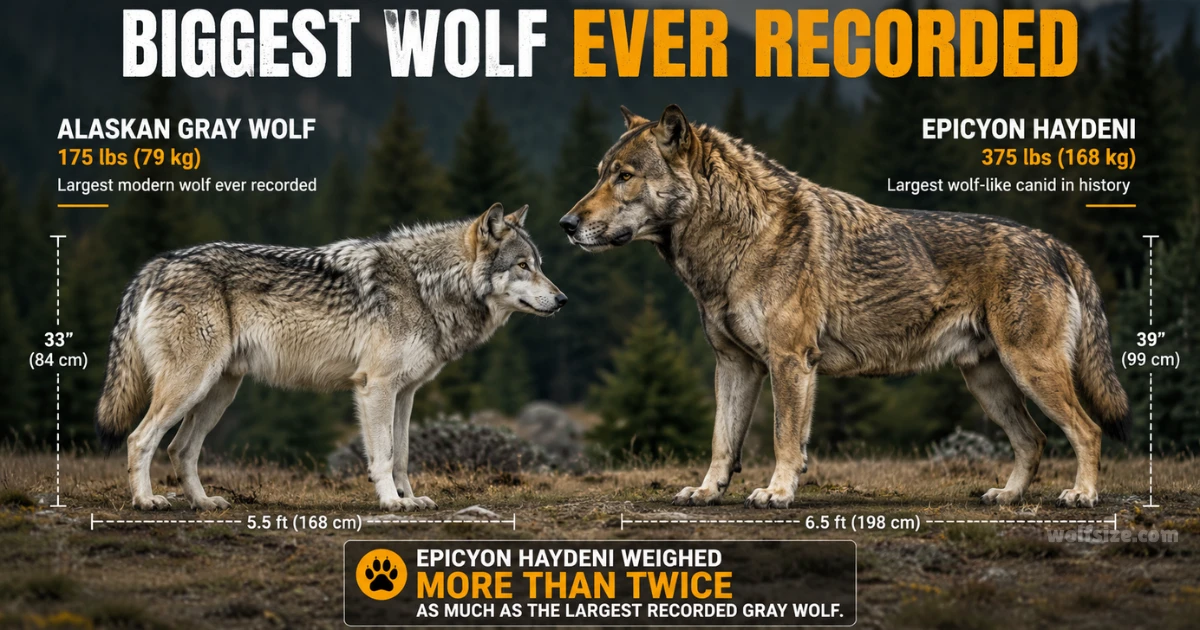
The biggest wolf ever recorded was a 175-pound (79 kg) gray wolf from Alaska, making it one of the largest modern wolves ever documented.
However, the largest wolf-like canid in history was Epicyon haydeni, an extinct bone-crushing dog that weighed up to 375 pounds (168 kg)—more than twice the weight of the largest known gray wolf.
Wolves have always captured human imagination. They are powerful, intelligent, and built to survive.
This article covers verified records, ancient giants, and the science behind wolf size — all backed by facts.
What Is the Biggest Wolf Ever Recorded?
The largest wolf ever officially recorded was shot in Alaska in 1939. It weighed 175 pounds (79 kg). Wildlife agencies documented this individual, and it remains one of the most cited records in wolf size history.
To put that in perspective — an average gray wolf (Canis lupus) weighs between 70 and 110 pounds. That Alaskan wolf was nearly double the typical weight.
A scientific principle called Bergmann’s Rule explains this. Wolves in colder, northern climates grow bigger bodies to conserve heat. Alaska and Canada consistently produce the largest gray wolves in the world.
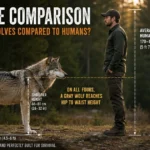
More Posts:Wolf Size Comparison: How Large Are Wolves Compared to Humans? 2026
Biggest Wolf Species Alive Today
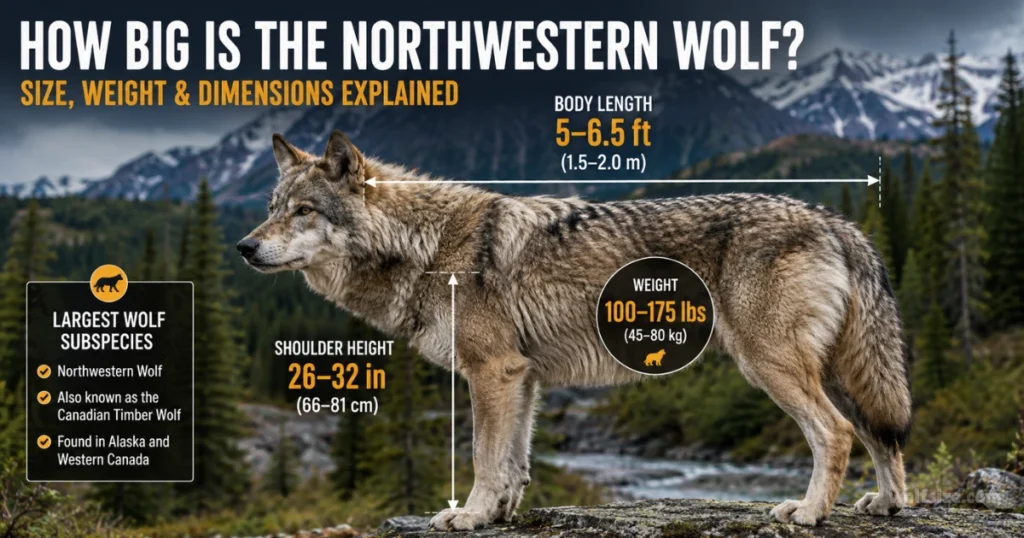
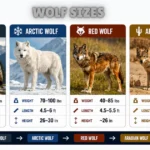
The gray wolf (Canis lupus) is the largest living wolf species on Earth. Within that species, the Northwestern wolf — also called the Canadian Timber Wolf (Canis lupus occidentalis) — holds the record as the biggest subspecies.
Key measurements for the Northwestern wolf:
- Weight: 100 to 175 lbs (45–80 kg)
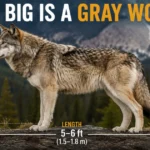
- Body length: 5 to 6.5 feet (nose to tail)
- Shoulder height: 26 to 32 inches
These wolves roam Alaska, western Canada, and the Northern Rocky Mountains — including Yellowstone National Park, where researchers have tracked some of the largest individuals in modern times.
Biggest Wolf in Prehistoric History
The Dire Wolf — America’s Most Famous Prehistoric Wolf
When people think of giant prehistoric wolves, the dire wolf (Aenocyon dirus) comes to mind first. And for good reason — it roamed North America for over 1 million years, right up until its extinction around 9,500 years ago.
Dire wolf fast facts
- Weight: Up to 150–160 lbs (68–72 kg)
- Build: Stockier, heavier bones than modern wolves
- Skull: Larger and more powerful — built for crushing bone
- Range: Across North and South America (fossils found at California’s La Brea Tar Pits)
But here’s what most people don’t know — a 2021 DNA study published in Nature confirmed that the dire wolf was not closely related to modern wolves at all. Its lineage split from the wolf family tree roughly 5.7 million years ago. It was a completely separate evolutionary branch that just happened to look wolf-like — a phenomenon called convergent evolution.
So the dire wolf wasn’t technically a wolf. It was something far older and more isolated.
Epicyon haydeni — The True Largest Canid Ever
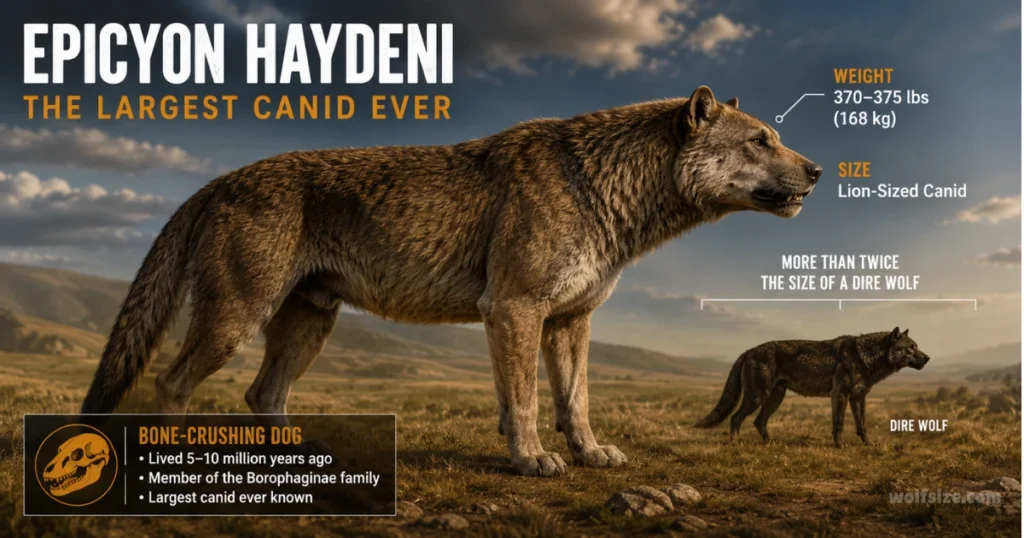
The actual largest wolf-like animal ever recorded was not the dire wolf. It was Epicyon haydeni — a borophagine, or “bone-crushing dog,” that lived during the Miocene epoch, roughly 5 to 10 million years ago.
Epicyon haydeni measurements:
Weight: Up to 370–375 lbs (168 kg)
Size comparison: Roughly the size of a
male lion Skull: Massive — equipped with carnassial teeth capable of crushing the largest bones of its prey
That is more than twice the size of a dire wolf. And nearly four times the weight of the largest modern gray wolf on record.
Epicyon was not a wolf in the true sense — it belonged to the Borophaginae subfamily, a now-extinct group of canids that dominated North America before true wolves arrived. But in terms of raw size, nothing in canid history has come close.
How Scientists Measure the Biggest Wolves
Size in wolves is measured four ways:
Body weight — most commonly cited in wildlife records Skull length and width — used in both fossil records and modern trophy documentation Total body length — measured nose to tail tip Shoulder height — used to gauge overall frame size
For prehistoric species, scientists rely on fossilized skeletal remains. Techniques like stable isotope analysis reveal what these animals ate, how big their prey was, and even what ecosystems they lived in.
One critical point — many viral “giant wolf” claims online are not verified. Photos circulate claiming 200+ lb wolves, but wildlife biologists consistently state that 175–180 lbs represents the realistic ceiling for a wild gray wolf’s body weight. Captive wolves, fed regularly, can grow slightly larger — but wild wolves burn enormous calories through daily hunting.
More Posts:Wolf vs German Shepherd Size: Which Animal Is Bigger? 2026
Biggest Wolves in the United States
The USA is home to some of the largest wild wolves on Earth.
Alaska — Consistently produces the heaviest wolves. Home to the 1939 record-holder and multiple documented individuals exceeding 130 lbs.
Yellowstone National Park (Wyoming/Montana) — Since wolf reintroduction in 1995, researchers have tracked large individuals from the Druid Peak Pack and Junction Butte Pack. Some males exceeded 130 lbs.
Great Lakes Region (Minnesota, Wisconsin, Michigan) — Wolves here average 70–100 lbs — smaller than their northwestern counterparts due to prey size and climate differences.
Northern Rocky Mountains — Medium to large-bodied wolves. Reintroduced Canadian wolves here tend to run larger than historic local populations.
Why the size difference across states? It comes down to prey availability, climate, and genetics. Wolves in areas with abundant elk and bison grow larger. Wolves in warmer climates with smaller prey stay leaner.
FAQ — Biggest Wolf Ever Recorded
What Is the Biggest Wolf Ever Recorded in History?
The largest verified wild wolf was shot in Alaska in 1939 and weighed 175 pounds (79 kg). In prehistoric terms, Epicyon haydeni—a massive canid—reached up to 375 pounds (170 kg), making it the largest wolf-like animal ever documented.
What Is the Largest Wolf Species Alive Today?
The gray wolf (Canis lupus) is the largest living wolf species. The Northwestern wolf (Canadian Timber Wolf) is considered the biggest subspecies, with some individuals reaching 175 lbs (79 kg) in the wild.
Was the Dire Wolf Bigger Than a Modern Wolf?
Yes. The dire wolf was generally stockier, heavier-boned, and more powerfully built than modern wolves. However, genetic studies show it was not a true wolf and diverged from the wolf lineage more than 5 million years ago.
Where Are the Biggest Wolves Found in the USA?
Alaska consistently produces the largest wolves in the United States. Wolves living in Yellowstone National Park and the Northern Rocky Mountains are also notably larger than wolves found in the Great Lakes region.
How Big Was the Largest Wolf That Ever Lived?
Epicyon haydeni, which lived approximately 5–10 million years ago, weighed up to 375 lbs (170 kg), making it the largest canid in Earth’s history. Most mainstream articles overlook this animal when discussing wolf size records.
Can Wolves Weigh 200 Pounds?
Extremely rarely, if ever, in the wild. Most verified wolf size records peak around 175–180 lbs (79–82 kg). Claims of 200-pound wolves circulating online are typically unverified or involve captive animals rather than wild wolves.

Robert Taylor is a content researcher and writer specializing in dimensions, measurements, and size comparison guides. He creates clear, practical content that helps readers understand real-world sizes and measurements with confidence. His work focuses on delivering accurate, easy-to-use dimension information in both U.S. and metric units.